
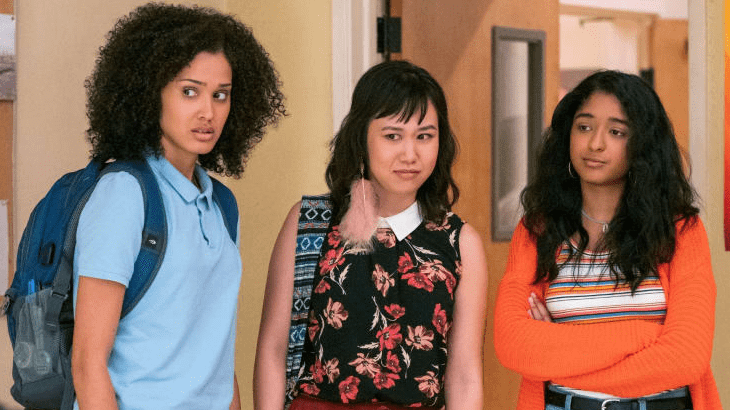
In this polarized political moment, when American diversity is under attack, we are ravenous for diverse representation in pop culture. But when we reduce art to its value in a particular political climate, and when we commodify identity, we compromise artistic integrity.
As the first Indian-American led TV show, Netflix’s Never Have I Ever understands that. The demographics of this country are changing—people of color make up 48%, and LGBTQ+ people 33%, of Gen Z, more than any prior generation. Never Have I Ever reflects this shift, including characters of every race but not making a single one a caricature. Protagonist Devi is smart, witty, angry, grieving, longing for popularity and acceptance, often selfish and occasionally cruel. Her race and culture inform her identity, but they don’t define her. The show handles these issues of identity with nuance, acknowledging Devi’s complicated relationship with Indian culture without letting that overshadow the typical high school issues she faces.
While it’s great that identity—racial, gender, sexual, cultural, etc.—is so much a part of American politics, it also means that our leaders who belong to marginalized groups are recognized first for the barriers they break and second for their characters and policies. For example, media coverage of Stacy Abrams revolves around the fact that she almost became the first female African-American governor in the country, while coverage of her former opponent, current Georgia governor Brian Kemp, focuses on his poor response to the coronavirus crisis. Media is reviewed the same way that politics is covered. Because white and straight have historically been, and still are, treated as the default, a movie or show with a predominantly white cast is assessed for its quality, but coverage of diverse media centers on its innovation in terms of representation.
Because minorities are so often misrepresented or unrepresented in art and pop culture, reviews of a book about a gay teen or a movie about a Black superhero become all about the identity politics, eliminating any opportunity to examine the complexity of the story. The only way to honor that complexity is by normalizing other diverse stories and integrating them into the mainstream. But making diverse casts the standard in Hollywood shouldn’t mean that we become color-blind. Movies and shows need to address, or at least touch on, characters’ race and culture. It’s not just significant now in 2020, it’s integral to our nation’s past, present, and future.
Toni Morrison said that “the best art is political and you ought to be able to make it unquestionably political and irrevocably beautiful at the same time.” The art, literature, movies, and TV that stand the test of time incorporate social commentary without becoming overbearing, and highlight aesthetic beauty without becoming frivolous. If we want our art to stand the test of time we need to celebrate its relevance not just within, but also outside, of this political moment. Black Panther isn’t just remarkable because it’s the first almost all-Black blockbuster, or even because it exhibits the many ways to be Black. It also features fantastic acting and cinematography. Simon vs. the Homo Sapiens Agenda isn’t a good book just because the main character is gay, it’s also a lovely exploration of family, friendship, and adolescent sexuality.
Identity and representation are critical, but they shouldn’t be understood as the most essential aspect of a work of art, as this focus on diversity can obscure the merits of a movie or book. Judging cis-gendered white public figures on the content of their work while overly emphasizing the identities of their minority counterparts reinforces inequality. While their representation might, tragically, be an anomaly, their talent is not. The more kinds of stories we tell about all kinds of people, covering the scope of America’s cultural and intellectual diversity, the more we will be able to appreciate these stories without obscuring their universal truths by reducing them to the identity of their creators.
 Vidette