
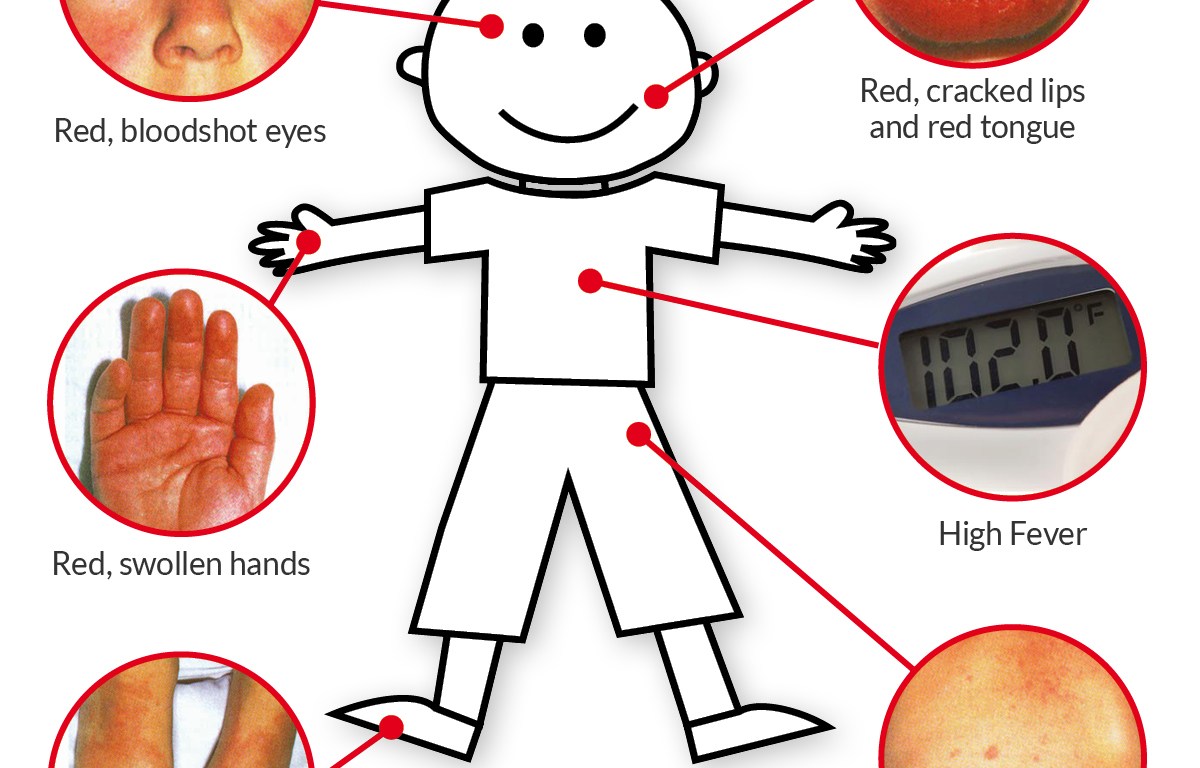
Image courtesy of Kawasaki Kids Foundation
Since the start of the pandemic, doctors and scientists have seen that viruses drift away and don’t affect children as much. But in recent weeks there has been a spike in a disease called Inflammatory Kawasaki Syndrome. Doctors in New York started seeing a rise in cases between April 27 and May 4.
Inflammatory Kawasaki Syndrome is a disease that has no predominant cause, but it is an overactive immune response. Doctors are not sure why or how children get it, but recently they have seen it more in children that have had covid-19. According to Dr. Steve Kernie, New York doctors have noticed that 50% of kids with Kawasaki disease test positive for Covid-19, while the others have covid antibodies.
The symptoms of Kawasaki Syndrome include fever, rash, strawberry tongue, bloodshot eyes, swollen lymph nodes, and swollen hands and feet. Children can also be irritable. Fevers around the temperature of 102-103 are most common, but some range from 104-105 and 100-101. Rashes can appear anywhere on the body; the back, abdomen, and chest are most common. Hands and feet can get red and swollen. The mouth and throat can appear irritated and red. Kawasaki Syndrome is not known to be contagious.
This disease is likely triggered by inflammation from Covid-19, but it can appear without exposure to Covid too. Lack of treatment can lead to Coronary Artery aneurysms. 25% of untreated cases resulted in an aneurysm, while 5% of treated cases experienced an aneurysm.
Most of the recent cases have not been confirmed to be Kawasaki Syndrome, and doctors are calling it Kawasaki-like. So, the treatment for some of these cases is not as severe as it would be if they were Kawasaki Syndrome.
Most children develop Kawasaki Syndrome after they have had Covid-19, or were exposed. The antibody test and the normal Covid test are used to see if they were exposed or had Covid-19. The disease is still very rare, and may be only a small part of the Covid-19 pandemic. What is very strange about this disease is that it has been most affecting healthy children without any other health conditions. Primary Covid-19 is affecting less healthy kids more.
75% of children diagnosed with the disease are under the age of 5. However, with recent cases more children have been in their teens. Boys are more likely to get to the disease, with a ratio of.3:1. Also children with Asian descent are more susceptible to the disease.
Treatment for Inflammatory Kawasaki Syndrome is aspirin and intravenous immunoglobulin (IVIG). The aspirin is used to control the fever, joint swelling, rash, and pain, and can also be used to prevent blood clots. The intravenous immunoglobulin is given in the early stages of the disease to prevent coronary aneurysms. Treatment for “Kawasaki-like” disease is supportive care. Children are put in the ICU if they need it and given IV fluids. Other drugs like steroids are used to lower inflammation, and medicine is used to keep blood pressure up.
Patients’ treatment for the syndrome can last anywhere from a few days to a few weeks in the hospital. After they have recovered, followup appointments are required. Children with Coronary aneurysms require lifelong follow-ups. Cases without coronary aneurysms require a number of follow-ups according to the severity of their illness.
The uncertainty of both Kawasaki Syndrome and Coronavirus has made both parents and children especially anxious during this worrying time. It is important, as ever, to stay connected as a community and work together to keep each other healthy.
 Vidette