
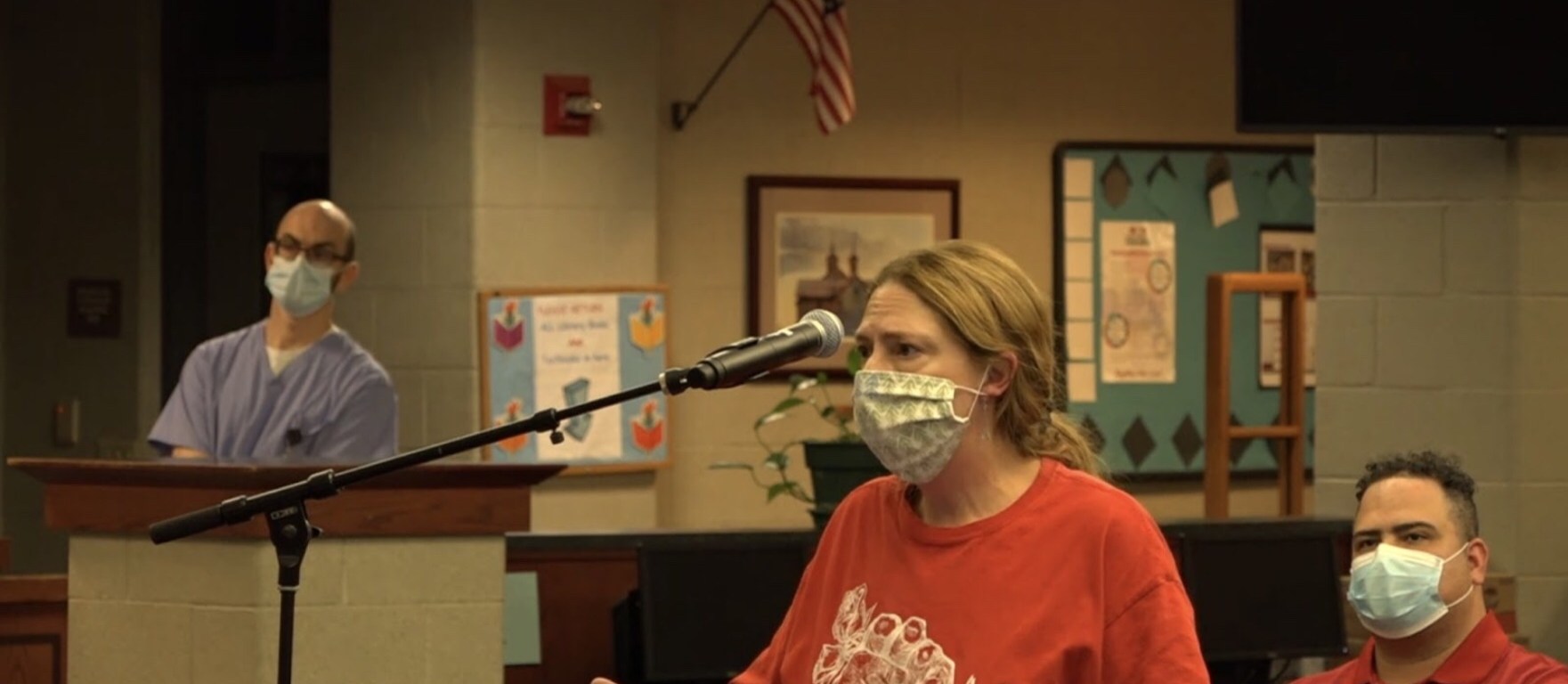
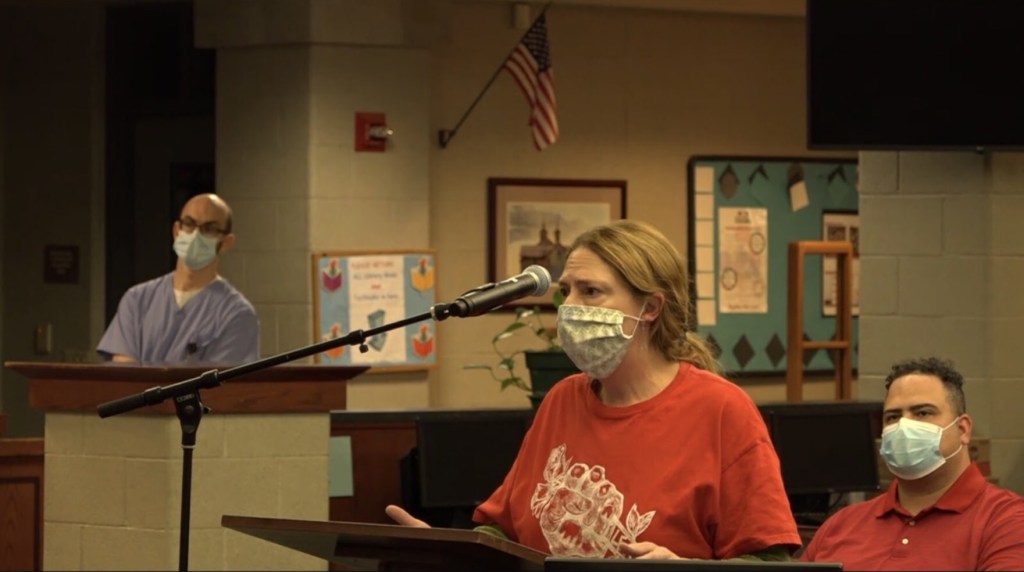
“These are some of the most difficult decisions that I’ve ever had to make in my life,” said Board President Dr. Edie Gallagher at the November 17 School District of Lancaster board meeting. “We receive tons of letters from parents who want their kids to be in school, and from parents who don’t want their kids to be in school. And from teachers who think we should be virtual, and teachers who think we should not be virtual.
“The board feels the heavy burden of the facts and the data. And that’s data about Covid, which we all know is skyrocketing in Lancaster county and around the country… But there is also the data like the information that Dr. Rau is giving us. Studies about students and their education and their future and their mental health and their successes and their failures.”
Prior to the start of Tuesday’s board meeting, the SDoL Teachers Union held a rally outside McCaskey East, calling for the end of in-person, hybrid instruction for the district’s elementary schools amidst an unprecedented spike in Coronavirus cases.
Students at Wharton, Ross, Wickersham, and King elementary have been attending school two days a week in socially distanced-cohorts since October 15th. However, on November 11, Fulton elementary was forced to close through the Thanksgiving Holiday because of positive tests among several students.
The atmosphere at the November 17 board meeting was tense. A number of elementary teachers said they felt ignored and alienated by the board’s previous decision to return elementary students to hybrid learning. Others pointed out that the number of Coronavirus cases in Lancaster county per 100,000 individuals was way over the state recommended limit for fully virtual learning.
“The data, the science, it’s speaking for itself,” said Joe Torres, the dean of Washington elementary and president of the Lancaster Educators Association. “(There have been) 240,000 deaths here in America. None of them yet though have been one of our students, and none of them yet have been one of our staff members. We don’t want any of those numbers to go up because of us.”
Many SDoL parents shared that because of the district’s hybrid model, they switched their children to private school. Others were not comfortable with their children attending in-person classes but were hesitant to enroll in SDoL’s Cyber Pathways Academy because of connections already forged with their school’s teachers, as well as the lack of a support system within the academy for students with special education needs.
“I can teach in any environment,” said elementary teacher Beverly Wilson. “I can teach at home, and I can teach in person. But I want to teach safely.”
District Superintendent Dr. Damaris Rau emphasized her sympathy towards these teachers and community members. But, she said, “We cannot let fear and uncertainty determine how our children will learn.”
Over 90% of children in the school district of Lancaster live in poverty, and many rely on their schools for food, emotional connection, and supplies. Their dependence is something that is exacerbated by the Coronavirus pandemic, where many parents are unable to find work or else cannot work because of health conditions.
Dr. Rau advocated for the continuation of the hybrid model in elementary schools. She read multiple letters from parents, staff, and teachers expressing gratitude for in-person learning and the positive impact it had on students: emotionally, socially, and academically.

“The point of these letters, the point of my statement, is that there are many many sides,” she said. “We have to decide not only what’s best for the adults, but we have to decide what’s best for the children.”
This was the one recurring theme throughout the board’s discussion: Children’s education should not be the first thing to go when adults act irresponsibly. Board members, some struggling to fight back tears, asked why restaurants, bars and malls should get priority over district families and students who have been working hard to curb coronavirus.
“The action of returning to virtual will be asking children to bear responsibility for adult errors,” said board member Dr. Dave Parry. “We’re not doing this to protect kids. We’re doing this to protect the community. And so we’re asking kids to take a big hit to themselves…whichever way we decide, I think we should acknowledge that that is profoundly unfair.”
After much discussion, the board decided unanimously that the current level of risk, especially in light of the upcoming holiday season, was too high to have elementary students and teachers in school. But it was a difficult decision, and certainly not one made lightly.
“Unlike some politicians, I am a mature person and I respect your decision. You have the right to make this decision, and we will make it work,” concluded Dr. Rau.
 Vidette