
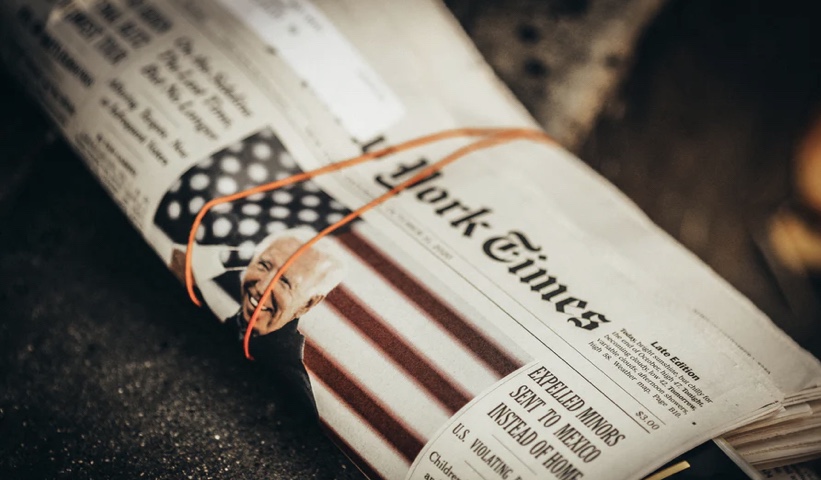
President Biden has made it clear that he’s sacrificing an opportunity for systemic change out of a desire to be palatable for everyone. As we celebrate the end of Trump, let’s not let cosmetically diverse Cabinet appointments distract us from the fact that Biden is a man who, a year ago, told billionaires that “nothing would fundamentally change” for them if he was elected. We need to pay careful attention to what our new President is doing in order to put pressure on him to do better.
Biden’s three top priorities are the trifecta of crises confronting our nation: the climate emergency, the coronavirus pandemic, and a mass reckoning over systemic racism. So let’s take a closer look at what he has – and hasn’t – done regarding these three issues.
- Race
On January 26, Biden signed an executive order regarding private prisons, and many news outlets reported that he had banned them. Abolishing private prisons has long been a goal for the left, as these prisons are run by for-profit companies often exempt from federal oversight, meaning that human rights abuses run rampant in these facilities. But Biden’s executive order far from ended them. Nearly 90% of private prisons are managed by states, counties, and cities, so his order didn’t affect those, and most federal private prisons are ICE detention centers, which Biden didn’t end either. His order only established that the contracts for a few private prisons wouldn’t be renewed, but many of those contracts last years.
Biden also needs to fulfill his promises to eradicate the federal death penalty, a barbaric punishment that disproportionately impacts people of color. As the architect of the 1994 Crime Bill, which broadly increased eligibility for the federal death penalty, there’s a lot of pressure on the President to rectify his past wrongs. While the most permanent way to eliminate capital punishment is through Congress, Biden can commute the sentences of the 50 prisoners currently on federal death row to life without parole, so none of those death sentences could be reimposed, with a simple stroke of a pen. He could also direct his Justice Department to not authorize prosecutors to pursue the death penalty.
And perhaps most impactfully, Biden could declare a state of emergency regarding racist policing. Since most appropriation of police funds falls to the states, this measure would expand Biden’s presidential powers, allowing him to subvert Congress and state governments by withholding funds from states that have blatant racial discrepancies in policing. Biden could also direct states to implement bias training and de-escalation and use of force protocols. And through federal agencies, Biden could prohibit no-knock warrants, such as the one that led to Breonna Taylor’s murder, and choke holds. Rules and policies are administered differently at the federal and state level, but since the federal government generally has more power than state governments, Biden has a lot of authority on this issue.
- Covid
One of Biden’s top priorities for combatting the exacerbation of economic injustice caused by COVID-19 is increasing the minimum wage to $15 an hour over the next five years. And while this is an admirable goal that progressives like Senator Bernie Sanders have been promoting for years, at this point, the only way to make sure the economy recovers from the pandemic and every American has enough to eat is to raise the minimum wage to $24 an hour. In fact, if the minimum wage increased with inflation and productivity growth, like it did in the first thirty years after its inception, that’s where it would be today. Congress passed a $740 billion defense budget by an overwhelming margin. Now that Democrats have control over Congress and the White House, why can’t they make the minimum wage a living wage, as FDR intended it to be when he implemented it? They could subsidize small businesses to keep them afloat and prevent corporate consolidation. And for fiscal conservatives who cite concerns about “the economy” every time a wage increase is proposed, if workers have higher wages, they can be more active consumers, buying more goods and putting money back into the economy, which would fuel economic growth at a time when it is desperately needed.
Biden’s actions regarding the health aspect of the pandemic have been mostly symbolic, such as implementing a “100 Day Mask Challenge” asking Americans to wear masks for 100 days, although obviously, it will require a lot more effort to convince alarmingly large swaths of the country that wearing masks isn’t going to turn them into Satan-worshipping pedophilic zombies. Biden’s other policies have been slightly more substantive. He reimposed travel restrictions for travellers from the UK, Ireland, and South Africa, where a 70% more infectious coronavirus variant has been spreading. He’s also directing the Federal Emergency Management Agency (FEMA) to set up community vaccination centers and instructing the Department of Education to investigate safe measures for returning to school. If a lot of Biden’s executive orders sound like bureaucratic chaos – directing an agency to do this and that, changing the designation of something, creating a new task force – that’s because it is, and it’s unclear what concrete impact these actions will have on our lives.
- Climate
One of the most significant actions Biden’s taken on mitigating the climate crisis is cancelling a permit to build the Keystone XL pipeline. The pipeline would have entered the U.S. in Montana and transported oil all the way to Texas. Environmental activists and Native American tribal leaders have long opposed such pipeline construction, as pipelines often spill, causing environmental devastation, they release methane gas, are detrimental to water quality, violate treaties over tribal land, and open doors to human trafficking. It’s not enough, of course, but it’s a start, and it shows Biden might be amenable to meeting some of the left’s demands on climate action. Biden also rejoined the Paris Climate Accords, an international treaty joined by Obama and abandoned by Trump, that resolves to collaborate to get greenhouse gas emissions to net zero and improve green infrastructure over time.
However, Bloomberg News reported that the Biden administration issued 31 new permits for oil drilling on federal land and coastal waters. This is concerning, because it contradicts some of Biden’s campaign promises to end oil drilling on protected land. And what’s even more concerning is that Bloomberg was the only major media outlet to report this.
So what does all of this mean for those of us who want to hold Biden accountable without becoming overwhelmed by all the noise? First of all, be careful about where you get your news. Headlines can be misleading, so make sure to read the body of the article as well. And remember every news organization, even the most reputable, have biases. A lot of corporate media organizations have connections to the Biden administration, both financial and personal, that are sure to influence what they cover and how they cover it.
iAnd secondly, remember it’s people power that creates real change in this country. It was the tireless advocacy of labor unions, not FDR, that made the New Deal the biggest piece of progressive legislation in the 20th century. What Biden’s done so far is a little bit of good, a little bit of bad, nothing major in either direction. Continuing to protest, strike, call elected officials, and yes, vote, will ensure Biden can’t ignore our needs.
 Vidette