
What is fair funding?
Many of Pennsylvania’s school districts, including our own School District of Lancaster, are not receiving adequate funding from the state. Part of this problem originates with property tax disparities. In Pennsylvania, education funding is collected through local property taxes; more expensive houses generate higher taxes, which produces more funding for school districts in affluent areas and reinforces economic injustice. In order to ensure equitable distribution of educational funds statewide, in 2016 the PA State Legislature passed the Fair Funding Formula. Through this formula, the funding a district receives is generally proportional to the share of Pennsylvania students the district educates, with additional dollars poured into districts that educate disadvantaged students. However, today, only new money added to the basic education funding budget – a mere 11.2% of the budget during the 2019-2020 school year – is distributed using the Fair Funding Formula. This is due to a policy called “hold-harmless” (referred to as “hold-harmed” by fair funding advocates), which stipulates that school districts get the same amount of funding they did the previous year, plus a small amount of additional new money. “Hold-harmless” spending doesn’t account for demographic changes, meaning the amount of money spent per student can vary between districts. And this funding deficit disproportionately harms students of color. Underfunded districts educate 51% of all students, but 78% of Black students and 82% of Hispanic students. We see these discrepancies in our own community. Only 12% of students in the School District of Lancaster are white, and we are underfunded by about $1,309 per student, according to an online database compiled by the organization Pennsylvanians for Fair Funding.
Fair funding lawsuit
In 2014, six school districts, including the School District of Lancaster, four public school parents, and two organizations, the Pennsylvania chapter of the NAACP and the Pennsylvania Association of Rural and Small Schools, filed a lawsuit with the state, asserting that Pennsylvania’s educational funding is so inequitable it violates the state Constitution. That case is finally getting its day in court. According to Katrina Robson, an attorney for the plaintiffs (the group bringing the lawsuit), the spending per pupil gap between the richest and poorest districts in the state amounts to $4,800. This is the widest gap nationally. Some of the defendants (those who are being sued), who include several Republican lawmakers, Democratic Governor Tom Wolf, and the Pennsylvania Department of Education, have attempted to paint a rosier picture of inequitable school funding. Attorneys for Republican House Speaker Brian Cutler characterized the debate as “routine policy dispute” and accused the plaintiffs of trying to “create a dystopian view of Pennsylvania’s education system.” But according to Susan Knoll, a local public education advocate, “There is nowhere else in the United States where you can have such disparity in wealth and funding between districts that are right next to each other.” While it’s gotten off to a contentious start, the trial is expected to last weeks, or possibly months. Several witnesses from different school districts, including our own superintendent Dr. Damaris Rau, will take the stand to testify about the impact of inequitable funding.
Protest in Harrisburg
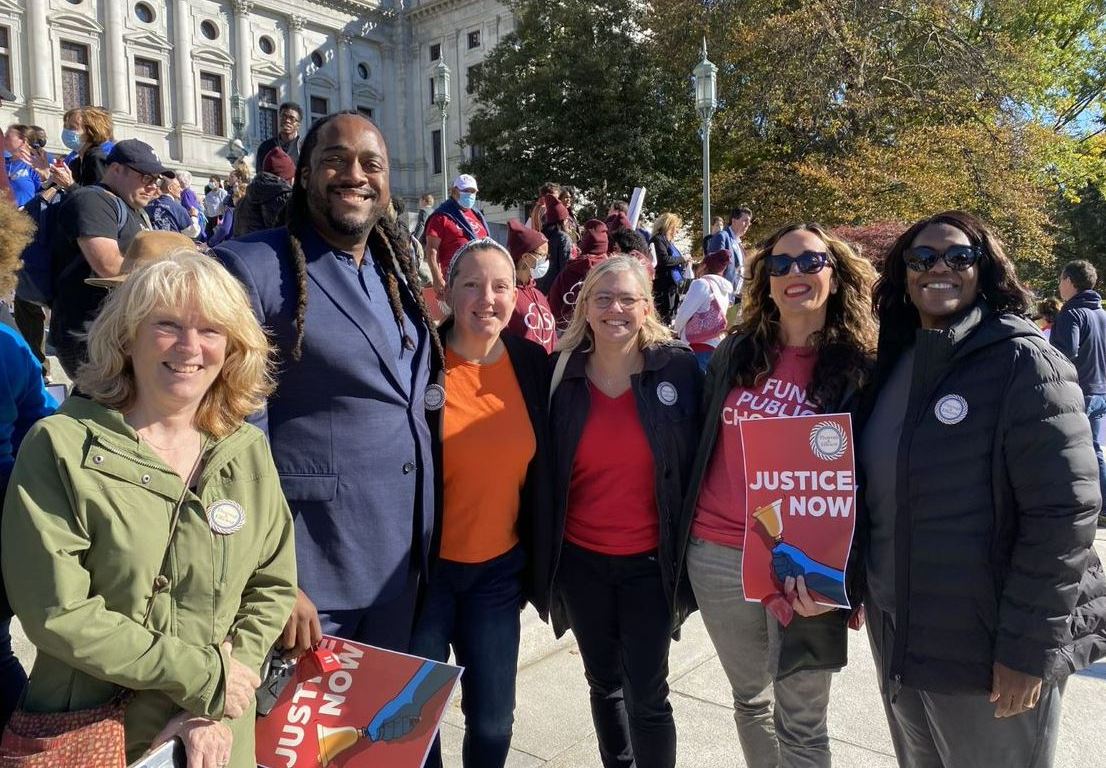
On Friday, November 12th at noon, over one hundred protestors from all over Pennsylvania attended a rally on the steps of the Capitol building in Harrisburg, advocating their support for fair funding as the trial began in the courthouse. Public school students and parents, community leaders, advocates, elected officials, and clergy eloquently spoke about how inequitable education funding affects their communities. The event was organized by PA Schools Work, a coalition of multiple education advocacy groups from across the state. Several members of our community, including School District of Lancaster school board members and City Councilman Ismail Smith Wade-El, were in attendance.
According to Knoll, “a lot of [the outcome of the trial] will come down to public pressure on lawmakers and general awareness of the issue.” She emphasized that organizers of the rally wanted to create a “visual presence” on the first day of the trial to gain media attention – and this strategy was effective. Several news publications, including the Philadelphia Inquirer, ran stories about the rally, increasing public engagement with the issue of fair funding.
Knoll has lots of ideas for students who want to make their voices heard in the fight for fair funding. “The one voice that has really been missing in this entire fight is that of the students,” she said. She suggests students connect with groups like the Philadelphia Student Union, meet with their lawmakers, such as State Senator Scott Martin and State Representative Mike Sturla, write letters to the editor for LNP, our local paper, and watch the fair funding trial when our district’s teachers and leaders speak.
 Vidette