
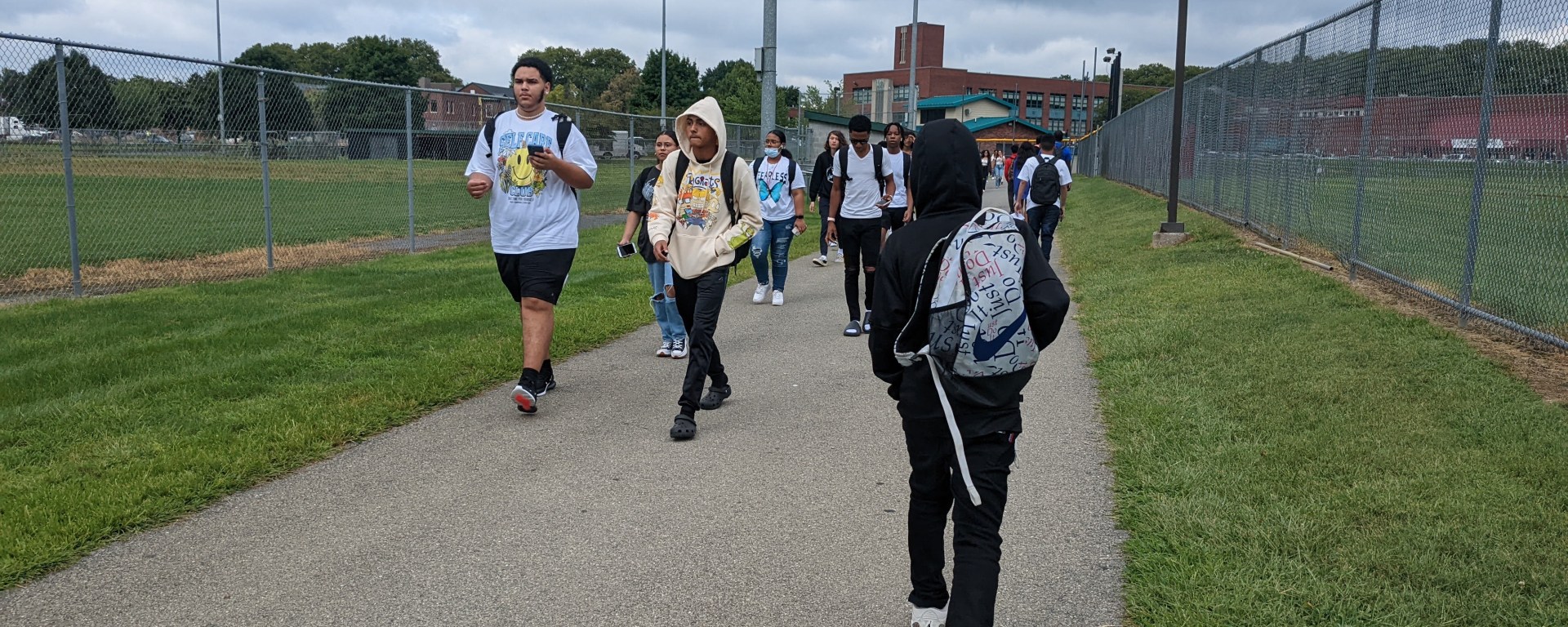
McCaskey High School currently has an attendance rate just above 90%. Of absences, most are unexcused. And over 50% of them come from freshmen, said Kathy Lutz, an Assistant Principal at the high school.
“When ninth graders come in, they don’t understand that this is the real deal here,” said Thomas Toczek, a guidance counselor at East. “You have to get credits to move on to the next grade. You have to get credits to move towards graduation. I think they’re used to elementary and middle where it’s not credit defined.”
But attendance issues don’t just take place amongst ninth graders.
“Not all families hold education at the same level of importance, but at the same time, a lot of our students are required at home or needed at home for family support,” said Elizabeth White, one of two student and family resource specialists at McCaskey, who provide students with everything from food support to individual counseling. She added that some students have to drop younger siblings off at school, take care of sick relatives, or work to financially support their families.
Mental health issues and stress levels can also keep students away. One 10th grader, who wished to remain anonymous due to the sensitive nature of the topic, said they’ve missed over two weeks of school just this year because of how stressed they were about their academic workload.
“I was missing, and teachers were noticing… that was even more stressful, so I just kept going because I was scared of getting in trouble,” they said. Misconceptions about the reasons students miss school can also be harmful. “It’s part of a reputation now,” the student said. “A lot of people are just like, ‘Oh, you miss a lot of school, because you’re just lazy, you don’t want to get up, you actually don’t want to go, or you don’t care’ – but that’s not true.”
Teachers are responsible for their own homeroom’s attendance this year. They’re supposed to call home if a student is absent, a move designed to help students feel supported, Lutz said. But it can be difficult to make a connection.
“I have a couple of students who I’ve seen maybe once or twice all year, and there’ve been letters to the counselor and everything like that…but I still have not seen them,” said Gabriel Painton, a McCaskey social studies teacher. “I definitely want to help them, but at the same time, too, at what point is it not fair to [the students here] for my resources to be used spending every day after school calling home and stuff like that…how many hours do these kids steal from the kids doing what they’re supposed to be doing?”
In the case of students who are still learning English, attendance is an issue of comprehension, said McCaskey English Language Development Teacher Kristen Kaminski. “For the kids I know that are coming to school, but they’re skipping, I honestly believe… [that] they’re overwhelmed,” Kaminski said. “And to put ourselves in their shoes, you have to imagine what it would be like to take biology, history and also American history [in another language]. And being teenagers, they’re too embarrassed to ask or [may] not even know enough English to ask for help.”
There are imposed motivators to attendance, like the reward of PBIS points and the threat of suspension, but the consequences of missing school are largely natural, said White. Grades drop, students are less prepared for life after high school, and they miss out on key social interactions.
“They’ve got to buy in and want to be here,” she continued. “And there’s a lot of factors that play into that: largely, how the adults treat kids and how safe and wanted kids feel… I think the majority of adults on campus want to be here and want the kids to be here…but you have to hook a kid, [especially] those kids that are going to be truant, or haven’t liked school until now, or have struggled at some point.”
According to school-specific data from the Future Ready PA Index, just 55.9% of students at McCaskey have regular attendance. That’s drastically lower than the PA statewide average of 85.8%, and is further dwarfed by the regular attendance rate of neighboring Hempfield High School, which stands at 87.6%.
A report from the US Department of Education found that students who are chronically absent, or miss 15 or more days of school, are seven times more likely to drop out of high school. Dropping out of high school has been subsequently linked to a decline in physical health and likelihood of getting involved with the criminal justice system.
“If you’re somebody who wants to choose your own path in life and you miss school….a lot of doors will close to you,” said Toczek. “That’s the reality of the country we live in: if you have an education, you can choose what you want to do.”
Coming to school can be difficult for many different reasons. Each student at McCaskey has their own life experience, background, situation and future goals. But good attendance can have an overwhelmingly positive impact on a student’s life.
“These four years are formative,” said Franklin Albrecht, a McCaskey student support coordinator. “We are instilling values in young people that will carry them into a successful adulthood.”
 Vidette