
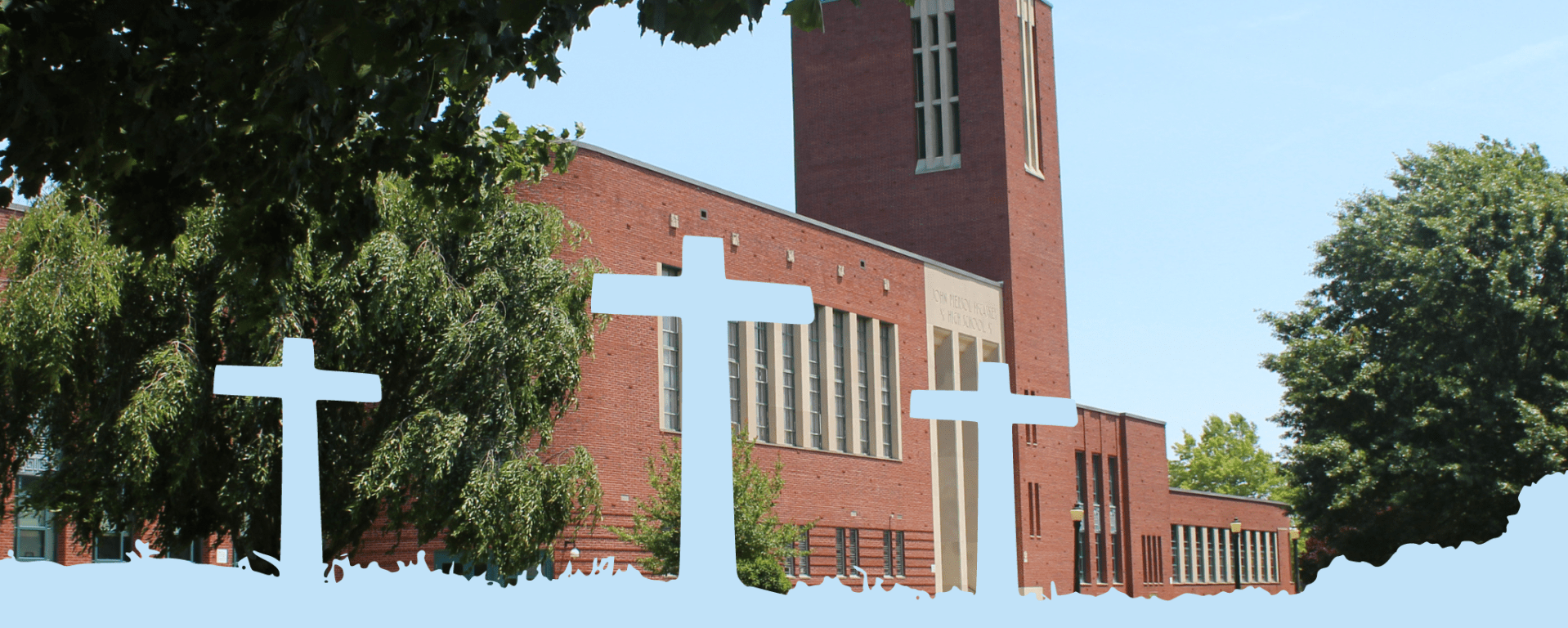
Cody Stonebank has a vision. A vision for “a revival happening within public schools and worship nights inside of school auditoriums leading students to encounter Jesus.” This vision violates a fundamental American principle: the separation of church and state. But that didn’t stop Stonebank and his movement, Unrestricted, from implementing it in our county.
Unrestricted, a branch of the Lancaster Fellowship of Christian Athletes, has hosted three worship services in public high school auditoriums so far: one at Garden Spot, one at Ephrata, and one at J.P. McCaskey, which were attended by approximately 280, 250, and 100 students, respectively. The events incorporate worship music, Biblical scripture, ministry time, and fellowship between students. Unrestricted posts about the events on Instagram (@unrestrictedofficial), but primarily relies on students to spread the word by distributing flyers to their peers. This enables the organization to maintain the facade of independence while exploiting school resources to ensure their messaging reaches their target audience.
In general, religious groups are permitted to rent public school facilities, just like any other interest group. But they aren’t allowed to promote their events as if they were affiliated with their host school. The problem is, Unrestricted meets in public high schools with the express purpose of evangelizing high school students. It’s not a Bible study quietly meeting in a classroom on a Sunday.
While Unrestricted isn’t associated with Lancaster County schools, its marketing strategy suggests the opposite. For example, an August 8th Instagram post features a photo of the McCaskey auditorium, captioned “Who else is ready to see this thing packed with a bunch of high school students on fire for the Lord, praising his name?”
The language of court opinions dictating whether churches can rent space in public schools is intentionally ambiguous. Because the first amendment (and the entire Constitution) was designed to be open to interpretation, there’s no definitive way to determine when a church has crossed the line, and similar cases have produced drastically different verdicts.
However, we can refer to the Bronx Household of Faith case, which was decided by the Second Circuit of the Court of Appeals in 2010, for guidance. The case established the demarcation between after-school programs that happen to include religion (allowed) and worship services (not allowed). “A worship service is an act of organized religion that consecrates the place in which it is performed, making it a church . . .They do not use a single, small classroom, and are not merely one of various types of groups using the schools; they use the largest rooms and are typically the only outside group using a school on Sunday,” reads the majority opinion, which ruled that services of this nature constitute a 1st Amendment violation.
Unrestricted’s events conform to this definition. They take place in the auditorium, generally the largest room of a school, and make no secret of their evangelizing mission. According to Stonebank, his goal is to galvanize students to “[see] their school as their mission field to bring the love of Christ to all students.”
The School District of Lancaster rents out school facilities through an application process conducted at the district level. Facilities are available to any group that adheres to safety procedures. But Unrestricted’s activities have made it abundantly clear that it’s time for the district to reevaluate this policy. If not, SDoL risks a community perception that they endorse religious messaging, as well as the potential for legal ramifications.
Stonebank and his colleagues are alarmed by what they believe to be a secular infiltration of public schools. But as government-funded institutions, public schools are inherently secular spaces. As refuges for intellectual exploration, schools should foster free thought about religion or any other topic. When we provide evangelical groups a platform within our schools, we compromise that value.
 Vidette