
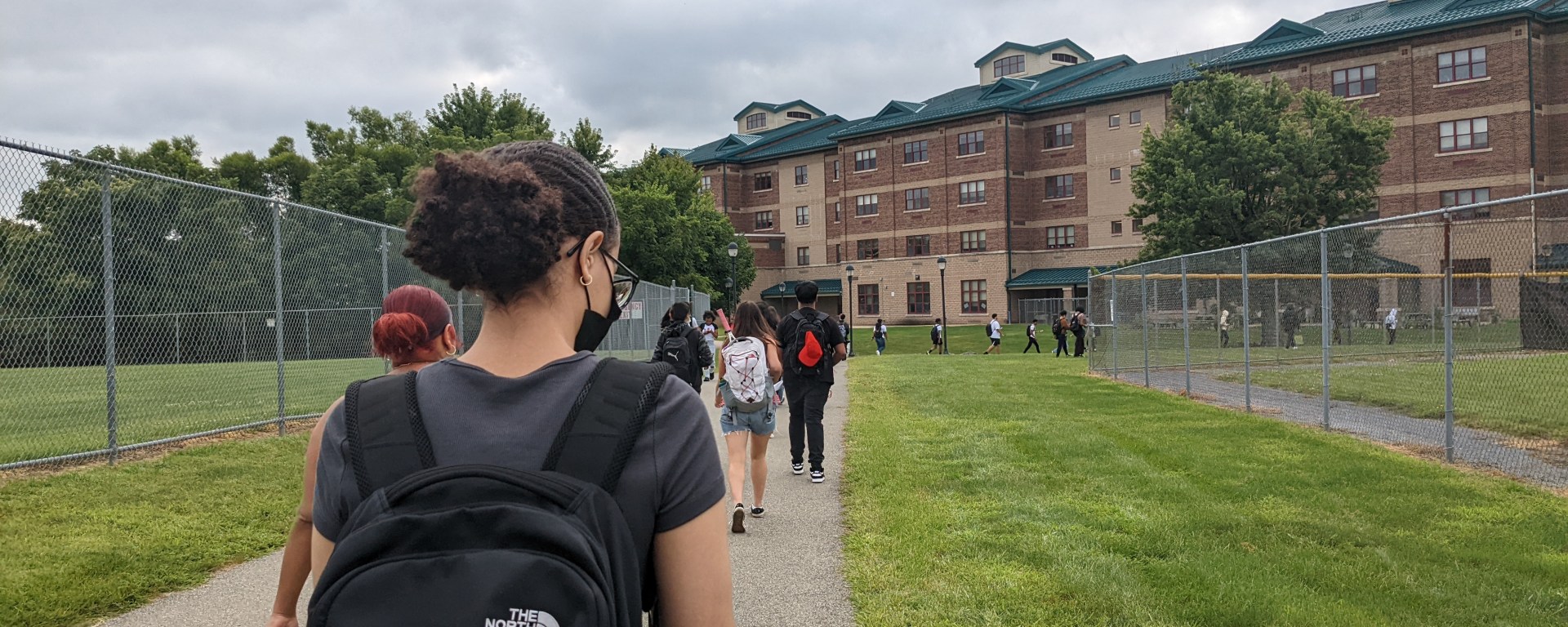
In everyday life at McCaskey High School, students face a problem when it comes to a long-running system between J.P McCaskey and McCaskey East. An issue not only affecting their ability to learn, but their motivation to go to class on time and in general. At McCaskey, ‘traveling’ is the system where you leave four minutes before the bell and walk to another building to get to your next class; which may seem to be a smart idea, but it has its fair share of problems.
A controversy surrounding this system is the time that students are given to travel, hand-in-hand with the amount of time it takes to travel. The average travel time, by calculating with a stopwatch everyday for the past three days, would be 7.4 minutes, from room 201 to room B103 (making it to B floor just in time for the 30 second bell). Why is this a problem? Well, a new rule implemented in the schools system is that students who are late to their classes without a pass are to be given In School Suspension or after-school detention. These rules have been causing a panic to travelers, rushing themselves to class in order to avoid these disciplinary measures or skipping. Can they be blamed? “If you’re going to be late, then why go anyways? I might as well just skip or take my time if I’m going to get in trouble,” a student (who wishes to remain anonymous) explained.
After interviewing a total of five students and two administrators, it became quite clear what the problem is and what could be the solution. Two students expressed that throughout the day, they travel once a day but tend to be late to class. “Some students crowd the halls and stairways, the doors get jammed, and no matter where you are— you have to leave at the exact same time as everyone else,” Brianna Dobbs, a senior at McCaskey, expressed. Brianna and another student suggested that travel release should be determined by your position in the buildings. For example: if you’re on D floor, you would get released six more minutes before the bell rings and a minute decrease for each floor and so on. The problem lies in students traveling from the back of the J.P building to the D floor of the East building. A collective agreement between students seems to be the timing of the release and the distance that needs to be changed.
Some administrators agree, while others disagree. During class, AP art teacher Mrs. Wolf had told a story of two student teachers walking from J.P to East at the same time students would. “They left at the same time and apparently had gotten there a minute after the late bell,” she told the class. “I don’t know how they expect students to travel in that period of time without running or rushing.” However, Mrs. Torres, an associate principal at McCaskey, had a different opinion on our traveling system. “Our school is set up like a college campus,” she began, “the idea behind traveling and having two buildings is to give students an idea of campus life. When I was in college, we had to constantly run back and forth to class in order to get there on time. Students don’t need more travel time. This amount is enough to help them stay on track with the end of their lessons.” Mrs. Torres proves to have strong opinions on the topic, but it could be argued that although students should use their time before traveling to focus on school work— class lectures usually come to a halt 10 minutes before the travel bell rings.
With students tired of the rush of getting from one building to another, teachers tired of the tardiness that comes from it, and administrators implementing new rules, it’s not quite clear what changes should be made in our school. Although it can be argued on why students should be grateful for the time they do receive, it can be equally debated that student’s deserve and need more time. Our school’s system has its strengths, but with every strength, there is a flaw to be discussed—and this is one that deserves to be surfaced.
 Vidette