
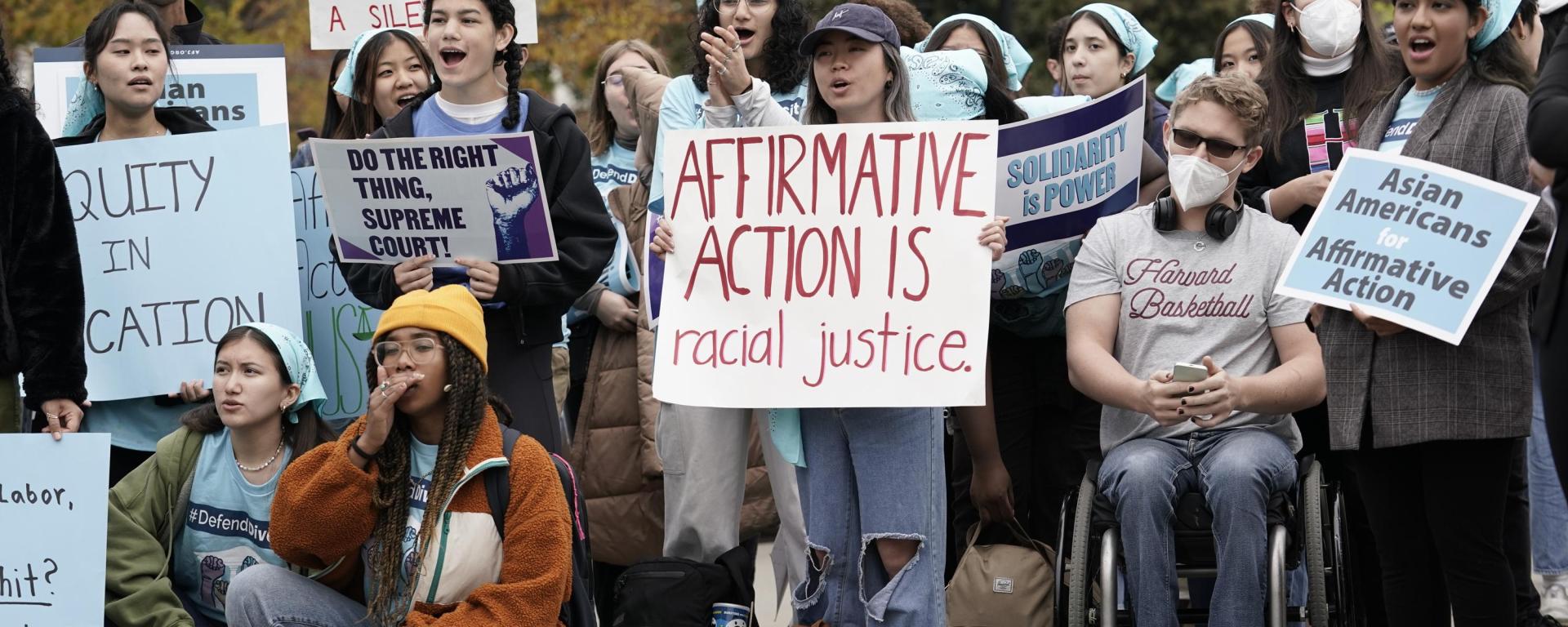
On October 31, 2022, the Supreme Court heard oral arguments in two cases that have tremendous implications for racial justice in America: Students for Fair Admissions v. Harvard and Students for Fair Admissions v. University of North Carolina.
Both cases revolve around the role of race in college admissions, a contentious topic in American politics that has spurred debates for decades. Proponents of race-based affirmative action argue that it increases racial diversity on college campuses and provides opportunities for low-income and minority students who suffer from societal disadvantages. Opponents postulate that affirmative action discriminates against Asian-American and white students, and denies qualified applicants coveted spots at elite universities.
There is ample court precedent affirming the legality of affirmative action. In 2003, the Supreme Court decided Grutter v. Bollinger, a seminal case in the affirmative action debate. Barbara Grutter, a white applicant to the University of Michigan Law School, argued that she was denied admission because of the school’s race-conscious admissions practices. In 2003, the Supreme Court ruled in favor of the university, asserting that the “compelling governmental interest” promoting in racial diversity in higher education justified the consideration of race in admissions.
However, while colleges can take applicants’ race into account, racial quotas were ruled unconstitutional in 1978 by Regents of University of California v. Bakke. This means colleges cannot establish numerical requirements for student diversity, or evaluate candidates within their individual racial groups instead of in the context of the general pool.
Students for Fair Admissions (SFFA), an anti-affirmative action nonprofit, argues that Harvard and UNC violated Title VI of the Civil Rights Act of 1964 by discriminating against Asian-American and white applicants, using “racial balancing” measures, granting race too much weight in the admissions process, and neglecting to employ race-neutral alternatives to affirmative action.
In both the Harvard and the UNC case, lower courts ruled in favor of the universities. SFFA brought its lawsuit against Harvard in 2014. The U.S. District Court for the District of Massachusetts ruled in favor of Harvard, citing a lack of evidence of “racial balancing” and Harvard’s use of holistic review, which involves the consideration of many factors in the admissions process. The district court also ruled that a hypothetical admissions program that replaced consideration of race with consideration of socioeconomic status was not a viable alternative, because it would decrease racial diversity and lower academic standards. The U.S. Court of Appeals affirmed the decision for Harvard.
In the UNC case, the District Court for the Middle District of North Carolina held that UNC’s consideration of race was Constitutional because race was utilized as a “plus factor,” not the sole factor in admissions decisions, and there were no adequate alternatives to race-based affirmative action.
While a ruling isn’t anticipated until June, the Supreme Court’s 6-3 conservative majority is expected to overrule Grutter and eliminate the consideration of race in college admissions. Justices Thomas, Alito, and Roberts have dissented in past cases where the majority ruled in favor of affirmative action. Based on the opinions he expressed in the October 31st oral arguments, Gorsuch is likely to join those three. Justice Barrett broached the subject of the informal 25-year limit on Grutter; Justice Sandra Day O’Connor, who penned the majority opinion in that case, wrote that “[we] expect that 25 years from now, the use of racial preferences will no longer be necessary.” It’s possible that the six conservative justices will hold that the Grutter ruling should expire in 2028, twenty-five years after the case was originally decided.
Affirmative action has long contributed to increased economic opportunity for minority students. Because of the U.S.’s correlation between race and income, Black students are twice as likely as white students to attend high-poverty high schools, while white students are more likely to attend affluent schools with more access to extracurriculars, sports, and college prep services. Affirmative action is one avenue for rectifying this inequality.
Misperceptions about affirmative action abound. Contrary to popular belief, white women may have been the greatest beneficiaries of affirmative action initiatives. Between 1967 and 2009, female college enrollment increased from 19% of all students to 44%. And a 2005 Princeton University study revealed that eradicating affirmative action in elite college admissions would have a negligible effect on white students, causing their acceptance rate to increase by only 0.5% points.
Race never gives an average applicant an advantage over a highly competitive one. But ending affirmative action will have devastating effects on Black and Hispanic enrollment in top colleges.
 Vidette