
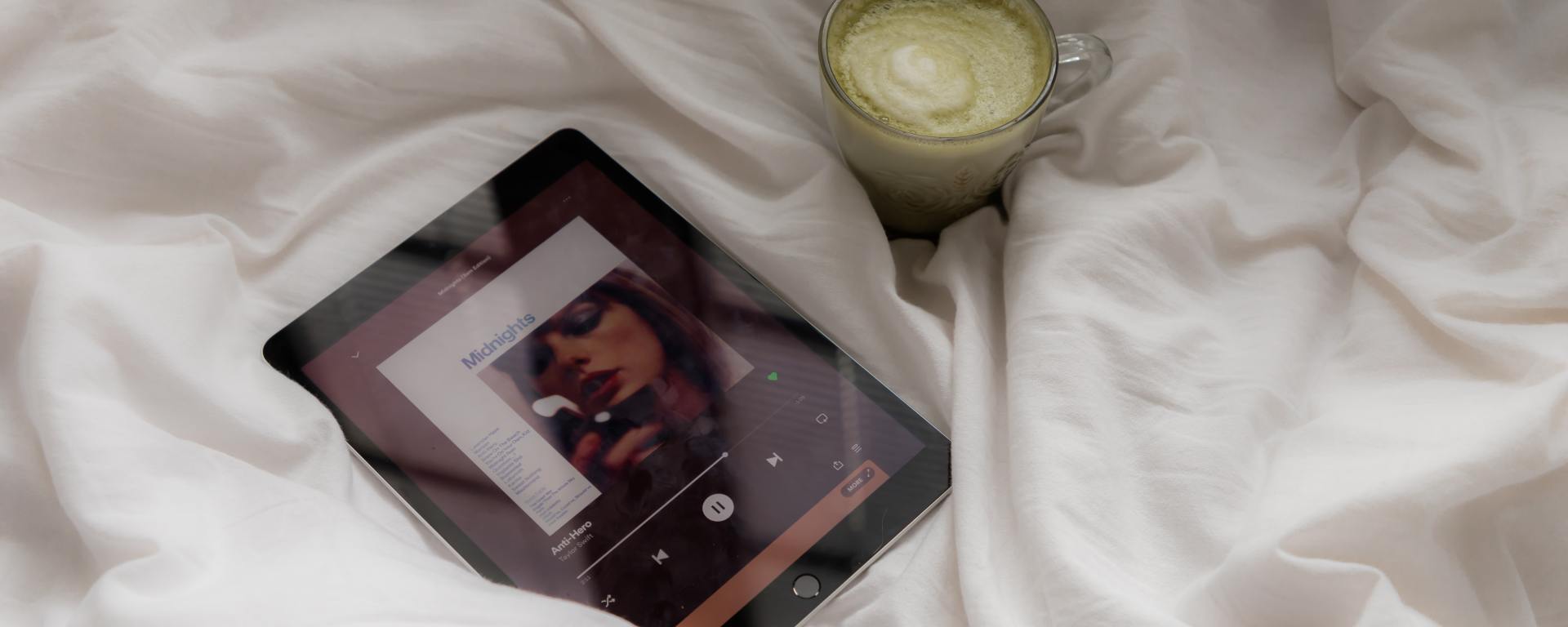
Taylor Swift is not known for being a master of subtlety. Much of her charm lies in her audacity, her refusal to let anything go. She transforms the details of her past relationships into devastating digs at her exes. But part of what made folklore and evermore, Swift’s indie-folk pandemic releases, so wonderful, was their nuance and introspection. Instead of lashing out, she looked in.
Midnights, Swift’s tenth studio album and splashy return to stadium pop, is anything but subtle. There are moments of genius, but also lyrics that sound hastily written and synths that need to be reined in. More atmospheric than 1989 or Reputation, the songs sound enveloped in a shimmering Autotune haze.
The album is thematically cohesive, if not musically. It’s a clever concept: who hasn’t spent a few midnights lying awake, indulging in emotional rabbit holes, revisiting past loves and heartaches? Yet it sprawls out in too many directions, from the delicate, vaguely Christmas-sounding “Snow On The Beach (feat. Lana Del Rey)” to “Vigilante Sh*t,” which sounds like a knockoff Billie Eilish song.
The best lyrics on Midnights echo the understated vulnerability of folklore and evermore, yet the heavy synths and sparkly pop beats project an invincibility that threatens to undercut the emotional depth. It’s a strange dichotomy, like Swift wanted to take off her mask and expose her authentic self to her fans, then changed her mind at the last minute. Lead single “Anti-Hero,” a Kate Bush-esque pop song billed as a montage of Swift’s insecurities, doesn’t reveal much more than that Swift struggles with depression and feels like a “problem” sometimes.
This is Swift’s first album-length collaboration with producer Jack Antonoff, and it shows. Antonoff’s penchant for synths often threatens to obscure the sharpness of Swift’s songwriting. On “Question…?”, she sings “What’s that that I heard, that you’re still with her?/That’s nice, I’m sure that’s what’s suitable.” It’s a wonderfully incisive line, but the woozy production takes away some of the bite.
“Mastermind” is one of the album’s best songs. The frenetic, pulsating beat complements the desperate need for control that the lyrics evoke. “I swear/I’m only cryptic and Machiavellian because I care” is a quintessentially Swiftian line: both precise and universally relatable.
The lush “Maroon,” another standout, is the ideal vehicle for Swift’s talent for imagery. “The burgundy of my t-shirt/When you splashed your wine into me” recalls the “wine-stained dress I can’t wear anymore” from 1989’s “Clean.” While Swift isn’t the strongest vocalist, she excels at the song’s moody, sensual low notes. And the ethereal “Labyrinth” captures the fear of falling in love, the need to “Breathe in, breathe through/Breathe deep, breathe out.”
Swift reunited with folklore and evermore collaborator Aaron Dessner to make “The Great War,” “High Infidelity,” and “Would’ve Could’ve Should’ve,” the best of the album’s eight bonus tracks. “Would’ve Could’ve Should’ve” belongs among the ranks of Swift’s masterpieces. The mismatch of the effusive, catchy melody and lyrical exploration of trauma works beautifully. “Give me back my girlhood/It was mine first” is a chilling line.
Dessner seems to encourage sophistication from Swift, while Antonoff, despite co-writing some of Swift’s best songs (“august,” “The Archer”), tends to draw out her flashier, heavy-handed impulses (see the aggressively on-the-nose “Karma”).
Midnights has garnered ample critiques of redundancy, an unfair accusation. Sure, the album isn’t breaking any new ground. It exists in a safe, comfortable place for Swift, who’s long defined the pop zeitgeist. But we can’t expect artists to constantly reinvent themselves – especially not Swift, an artist who’s ventured into country, pop, indie, folk, even R&B inspired sounds.
A fairer criticism is that Swift’s financial motivations often transcend her creativity. Generic lyrics like “It’s me, hi, I’m the problem it’s me” sound tailored for TikTok. While it’s a cynical interpretation, one wonders if Swift sacrificed lyrical specificity for stadiums and viral hits.
Midnights is a good album. But it isn’t great, and we know that Taylor Swift is more than capable of great.
 Vidette