
By Nemari Morales
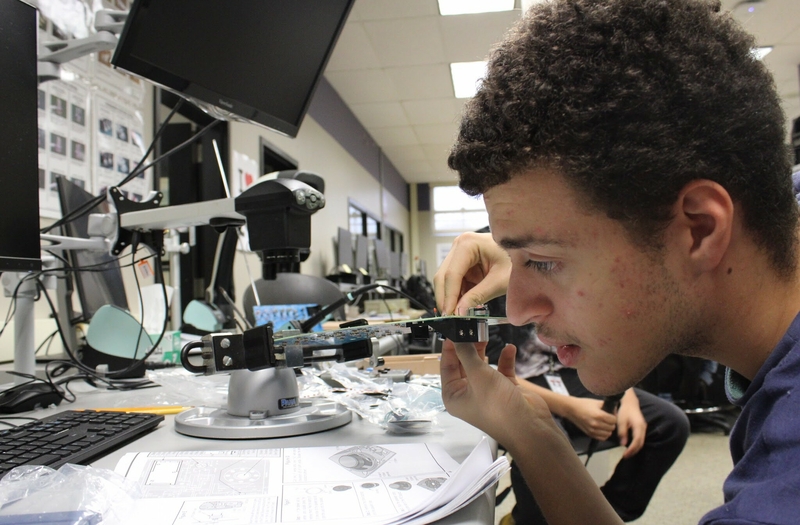
Fighting an unjust government isn’t on your typical middle schooler’s roster, but for Moustafa Hamed, a 12th-grade electronics student at McCaskey, a nightmare became a reality.
Moustafa was just 13 years old when his mother, Reem Desouky, was accused of running a Facebook page that criticized Egypt’s president. Desouky was immediately arrested on charges including “promoting a terrorist group and publishing false news,” according to The Inquirer.
Worried for his mother, a young Moustafa created and shared a video online pleading for help regarding the release of his mother. The case gained notoriety as different news outlets and journalists covered the topic, and eventually, Desouky was released after 10 months and returned home. This situation was a major turning point in Moustafa’s life, but even with such a tragic history, his backstory isn’t close to being one of the most interesting things about Moustafa.
Most people who have met Moustafa would describe him as a happy-go-lucky person who has energy for days. When interviewing him, I noticed how often he’d jump around or pace, rambling about the things he was passionate about. He’s someone who can bring smiles to any room with his antics, may it be crab walking around the McCaskey track twice, or engaging in a silly yet heated debate on Goldfish versus Oreos. Yet, there are a million sides to everyone, and I acquired an interest in finding a different side to Moustafa – what makes him so happy, and how does he believe others can obtain this trait?
Sitting on the stairs of the J.P. McCaskey lobby, I asked Moustafa a few questions to direct the conversation toward a deeper discussion. I started off with a very bold question, asking Moustafa what he thought the meaning of life was. “That’s an interesting question,” he said. “The meaning behind it is what you want to do as a human. Something you strive for – and if you don’t have one, create one. There’s always a possibility out there.” Following this statement, Moustafa describes how simple talents like creating art can be turned into careers, and that the options our society has today are endless – seize one!
This didn’t completely answer the questions I had in mind, and I took another step further to get a look into Moustafa’s mind. I asked him what he did when he felt sad (which seemed rare) to cheer himself up. He immediately responded with an answer that concerned me, saying, “I hide it.” Originally, I’d noted that his method of coping wasn’t the healthiest, but it seemed to work for him as he continued to elaborate on the effects of it. “For about 99% of sophomore year, I was depressed, but by forcefully bringing positive energy to myself, I actually felt happier,” he said. After answering this question, he turned the interview on me, asking me a few irrelevant questions about bananas and potassium. When I detected what he was doing, I asked him if he used random questions and queries as a way to distract himself from the profound topic of our discussion. Jokingly he told me, “You caught me.”
Moustafa and I began to spiral down a rabbit hole, discussing the aspects of life that we believe do or do not make a person “happy.” Because Moustafa had already spoken about pursuing the things you love, I asked him if the pursuit of knowledge was what brought a person peace. With his constant silly yet intriguing questions and his interest in electronics, I expected a far different answer than the one I was given. Moustafa looked at me, asking, “Think about it. Do you think Einstein was a really happy person when he became a scientist?”
His question brought some confusion to my mind, having never really contemplated something like that. This brought the two of us to a conversation on what stops happiness, and Moustafa began a tangent on what he personally believed did so. “Our own cultural thoughts on what a job is makes us not happy. You’re not working under someone, and sure, you like what you’re doing, but now, it’s more of a competitive thing.” He describes that there’s always an underlying battle to stand out – using the man who created the wheel as an example, where his contributions to society are overshadowed by the more recent creation of cars. With all this talk of things that destroy the purpose of life by his claims, I decided to finish off with a final question – what does he believe truly makes a person happy?
“Simply interacting with friends or family. In our base form, humans are social creatures. We are incredibly social creatures – even the ones who stay quiet most of the time will find themselves talking in some way, shape or form.” Moustafa was right – studies show that human interaction is a wildly important part of our lives, close to our needs for food and water. With all of this said, I was able to get an understanding of what Moustafa truly believes is important in one’s lifetime.
Overall, Moustafa believes that engaging with other people while doing the things you love will lead to a more positive life. He displays these principles within his own life, happy to crack jokes with people while being quick to try out anything he sets his mind to. His motivation to go about the motions of daily life despite his past is surprising, but he doesn’t let it stop him. In his own words, “Life is like a fruit. It starts off bitter – you might have a bitter beginning, you know? But eventually, at some point, it’ll grow to be sweet.”
 Vidette