
By Gabriel Brogan
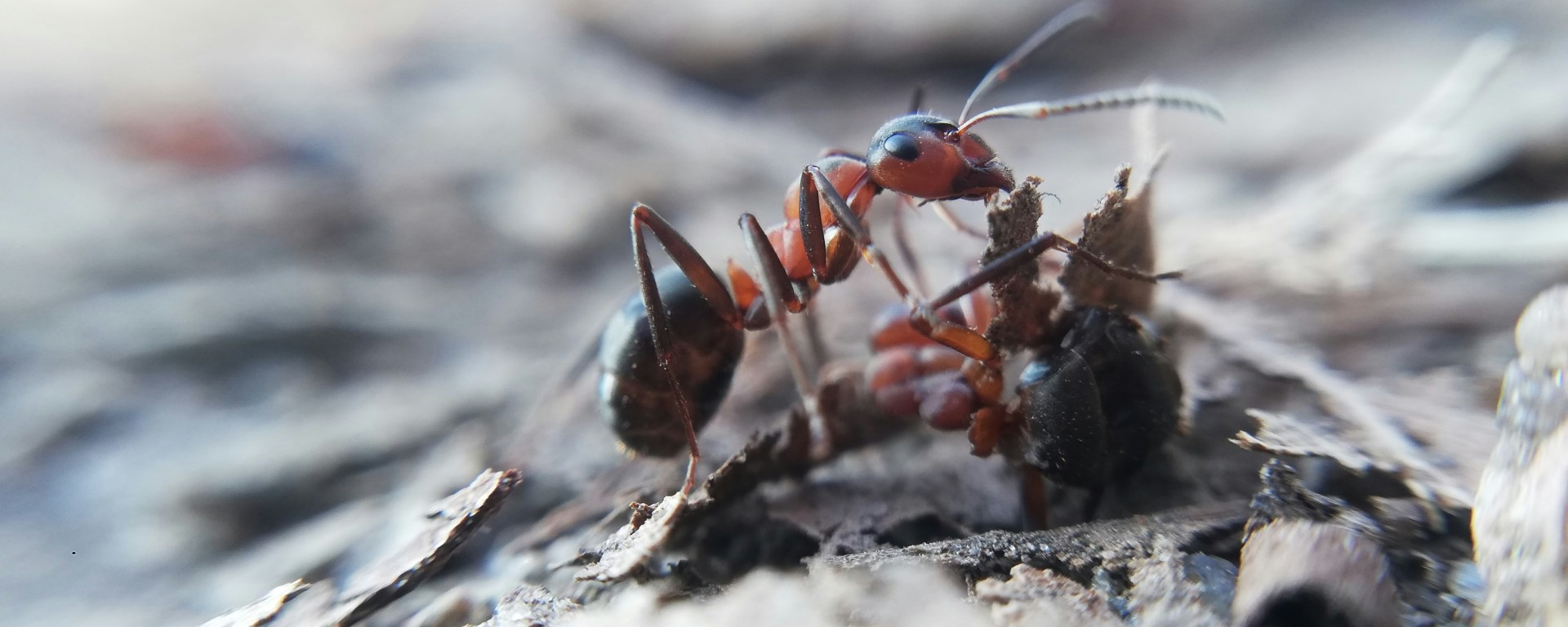
Not many people pay much attention to the creatures that sneak into our homes, eat our watermelon rinds, and make little hills in our parks. But ants are a lot like us. They cultivate crops, clear roads, and treat epidemics. There is also a darker side of ant (and human) nature. Like miniature empires, ant colonies expand their territories, create satellite colonies, and fight over territory and other resources.
When ants fight, it’s no skirmish. There are 20 quadrillion ants on earth, 2.5 million ants for every human, more biomass then all the combined wild birds and mammals on earth. Their colonies can range from 1,000 to 306 million, (in the case of one massive colony in Japan) but established colonies often have hundreds of thousands of members, and their battles involve tens of thousands.
A clash of ant colonies is akin to a clash of entire civilizations, every single ant in the colony contributing to an existential struggle for the existence of everything they know. A confrontation of ant armies will see lines of ants stretching for several meters on each side, ants charging in even when certain death is inevitable, massive soldiers known as “Supermajors” carving swaths into enemy ranks, and sometimes the capture of enemy ants for slave labor in the colony.
These battles leave behind an entire slaughtered army. Once they engage, ants do not retreat. Victorious armies go on to sweep the losing colony, usually killing the opposing queen and therefore erasing all hope of survival for their enemies. Occasionally, they will adopt the losers into their own colony to mitigate resource destruction.
Individual colonies are constantly struggling against their neighbors, making ants an incredibly politically divided genus. Even ants of the same species fight. Ants kill the most ants of any other animal. However, there are a few ant species that break this mold, and create “super colonies.” Most notably, the Argentine Ant.
The Argentine ant species has a few main super colonies, massive societies spanning continents. Any two ants from a super colony will recognize each other as colony mates, and cooperate instead of fight. The largest Argentine supercolony spans 3,700 miles, from the Portuguese Coast to Iraq, and has presences on other continents as well. Though these super colonies represent a rare order among ant colonies, they are not without conflict. And when they come into contact, their battles are on the scale of millions and even billions of combatants.
In San Diego county in Southern California, the main Argentine supercolony (known as the “Very Large Colony”) has clashed with the Lake Hodges supercolony for nearly 3 decades. The front lines of this conflict stretches for miles, getting pushed back a few meters here, a few meters there but never significantly shifting. It’s the WWI of ants, a war of attrition which claims an estimated 30 million ants per year. The colonies battle atop massive mounds of corpses that have accumulated over the years, ant bodies compacting and decomposing as more and more fallen soldiers join the pile.
This is not the only supercolony war of its kind, just the most devastating. Argentine Ants clash where supercolonies meet all over the world. Global casualty estimates are nearly impossible to make, but certainly high.
Most of us here at McCaskey go about our lives in relative peace and security. Every day, we go to school, play sports, do homework, practice instruments, and take care of siblings. A struggle in which every human in say, North America, is locked in a deadly struggle for continued existence with everyone in Europe is nearly impossible to imagine. But such conflicts on such a scale are at work beneath our feet, every day.
Do not take our stability for granted. Remember the Ant Wars.
 Vidette