
By: Sofia Escudero
In the International Baccalaureate (IB) program, one subject that many students complain about is World Languages. Learning French, Spanish, or German can feel hard, confusing, and sometimes unnecessary. A lot of students ask, “Why do we even need this?” However, IB World Languages provide students with important and useful language skills that will become essential to them later in life. Learning these languages helps students communicate better, understand different cultures, and become more confident and open-minded people.
To start, a big reason IB World Languages is valuable is because they help us communicate with more people. English is spoken in many places, but not everywhere. French is spoken in countries like France, Canada, parts of Africa, and even some islands. Spanish is spoken in Spain, Mexico, and most of Central and South America. German is spoken in Germany, Austria, Switzerland, and other parts of Europe. When you learn one of these languages, you can talk to millions of people around the world. Even if you only know the basics, it can make a huge difference when traveling or meeting someone from another country. Saying simple things like “hello,” “thank you,” or ordering food in another language feels really cool and shows respect.
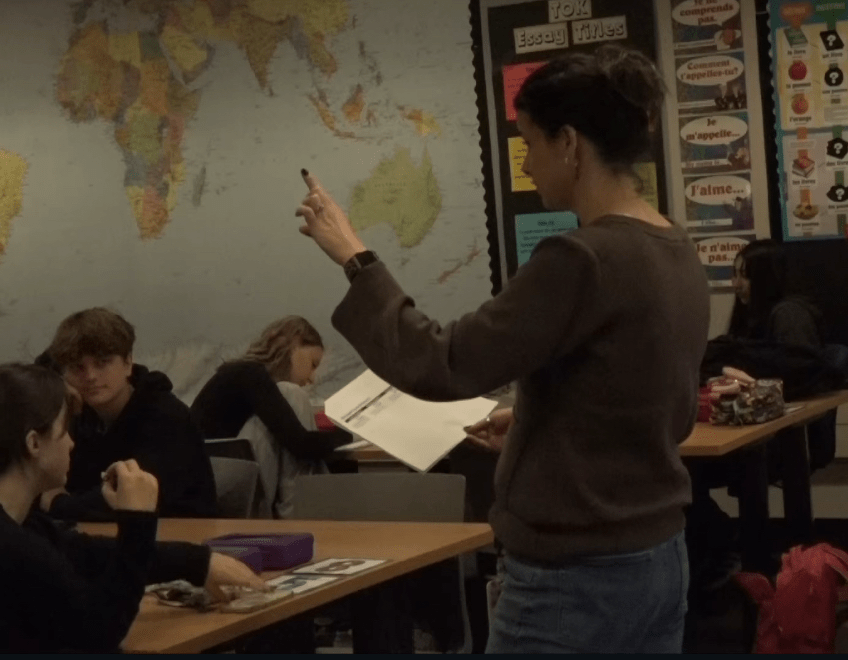
Another important part of IB World Languages is learning about culture. Language is not just words and grammar, it is connected to how people live, think, and act. “There are so many words which can’t be translated. This gives us an opportunity to go to these countries and learn our overall differences.” said Mrs. Browning, the Theory of Knowledge and French teacher. In French class, students learn about French food, holidays, and traditions. In Spanish, you learn about different cultures from many countries, not just one. In German, you learn about history, festivals, and daily life in German-speaking countries. This helps students understand the simple fact that the world is in fact much bigger than their own country. It also helps us stop judging people too quickly, because we learn why people do things differently.
IB World Languages also help your critical thinking skills. Learning a new language is like a workout for your mind. You have to remember vocabulary, learn grammar rules, and practice listening and speaking. This can be challenging, but it actually improves memory and problem-solving skills. Studies show that people who learn more than one language are often better at focusing and multitasking. Even though it can feel frustrating when you don’t understand something, that struggle helps your brain grow more powerful.
Another reason these languages are useful is because they can help in the future with jobs and school. Many colleges like to see that students studied a foreign language, especially in a program like IB. It shows that you are hardworking and willing to challenge yourself. In the future, knowing French, Spanish, or German can help you get a job. Companies that work internationally need people who can communicate with different countries. Spanish is especially helpful in many jobs because so many people speak it. German can be useful for engineering, science, and business, and French is often used in diplomacy and international organizations.
IB World Languages also help students become more confident. At first, speaking in another language can feel embarrassing. You might mess up pronunciation or forget words. But over time, you get more comfortable. When you realize you can understand a conversation or write a paragraph in another language, it feels like a big accomplishment. This confidence doesn’t just stay in language class, it can help in other subjects and in life too. You learn that it’s okay to make mistakes and that practice really does help.
French, Spanish, and German are especially good choices because they are widely spoken and connected to many cultures. Spanish is often considered one of the simplest languages for English speakers to learn, which can be encouraging. French has similarities to English words, which makes reading easier over time. German may seem hard at first, but it is very logical, and once you understand the rules, it starts to make sense. Each language has its own challenges, but that makes learning them more interesting.
In conclusion, IB World Languages may seem difficult or annoying sometimes, but they are actually very valuable. Learning French, Spanish, or German helps students communicate with more people, understand different cultures, improve their thinking skills, and prepare for the future. It also helps build confidence and teaches important life skills like patience and perseverance. Even if you don’t become fluent, the experience of learning another language is something that stays with you forever. IB World Languages are not just a school requirement, they are a door to the world.
 Vidette