
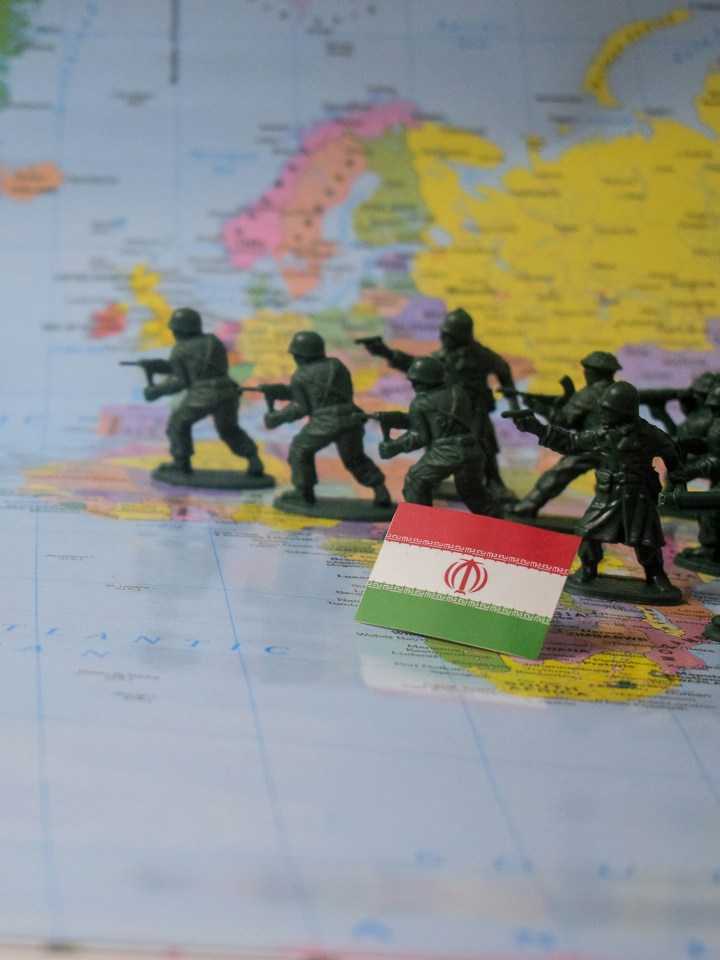
In 1898, the Spanish-American War was coming to an end. A bloody conflict between the United States and Spain over imperial control of a few islands looked like it finally had a victor after years of arduous fighting. On December 10th of that year, the Treaty of Paris was signed, transferring Cuba, Guam, the Philippines, and Puerto Rico to American control for $20 million. Today, the United States still controls Guam and Puerto Rico. To understand the significance of American imperialism and its connection to later conflicts, such as the Iran war, we must consider how these actions shaped U.S. foreign policy and global influence.
The Spanish American war was not the beginning of American imperialism. Rather, the war signified a new era of imperialism—one in which the United States would become a dominant imperial power. Under the guise of “bringing freedom and democracy” to other states, the United States would make its presence known.
One example of this is Eisenhower’s 1954 invasion of Guatemala. Before the invasion took place, Guatemala had elected the leftist Jacobo Árbenz Guzmán as its president. Guzmán promised to nationalize the agricultural industry away from the United Fruit Company, now known as Chiquita. The nationalization of this land angered then-American President Dwight D. Eisenhower, who ordered a coup in Guatemala to protect United Fruit Company profits. The coup was successful, and farmland was returned to American corporate control. Invasions like the one in Guatemala show past American imperialism, but how did modern imperialism play out?
In 2001, arguably the most important event in modern United States history would occur. Al Qaeda terrorists had hijacked four planes, two of which hit the twin towers, another crashed into a field, and another into the Pentagon. These events, now known as 9/11 because they happened on Sept. 11, led to widespread fear of Muslims across the country. But the events of 9/11 also provided an opportunity—an opportunity to justify war. Through widespread fear of so-called “Muslim terrorists” and supposed “weapons of mass destruction” in Iraq, then President George W. Bush would launch the Iraq War in 2001, which was part of a broader “War on Terror” to rid the Middle East of terrorism through the means of military destruction. While the pushed reasoning for the war already seems weak now, as the Americans never found weapons of mass destruction in Iraq, the real reason for the war further undermines this reasoning. The United States wanted to economically imperialize Iraq through control of its oil. This becomes obvious when looking at the fact that Iraq switched from selling oil in dollars to euros in 2001–undermining the power of the US dollar right before the Iraq war, angering President Bush. All in all, Iraq is the perfect example of the modern American imperial model, which would also be employed in Libya.
The Libyan war—despite being ten years after the Iraq war—shares many parallels with the Iraq war. Both resulted in regime change and the reinstating of oil conglomerates in the countries. The Libyan war resulted in the deaths of leftist leader Muammar Gaddafi, who, much like Guatemala’s Guzmán, nationalized oil industries. Much like with Iraq and Guatemala, America’s lack of control over Libya’s vast resources angered them, as evidenced by the invasion of Libya by American and NATO forces in 2011. The invasion led to Muammar Gaddafi suffering a brutal death at the hands of rebels supported by Western forces. Afterwards, the United States reinstated oil companies in Libya, all while Libya fell into total disarray. From civil war to power struggles, post-Gaddafi Libya was anything but stable. In fact, the situation was so bad that President Obama would call his handling of Libya his “worst mistake” as president of the United States. Many aspects of the Libyan war—just like the Iraq and Guatemala wars—are seen in the modern-day invasion of Iran.
The current war in Iran is quite complex and requires proper context to be understood. To begin, Iran elected Mohamed Mossadegh in 1951. Mossadegh brought hope to the corporate-run Iran. He promised to nationalize Iran’s oil industries from British oil companies like British Petroleum. Mossadegh—an open progressive Muslim who advocated for a secular and free Iran—was killed by the CIA in 1953 and replaced with the Shah Mohammed Rena Pahlavi with the main goal of bringing Iranian oil to the United States. Under the Shah, Iran experienced rampant repression and unequal wealth distribution.All of this would eventually lead to Iran’s Islamic Revolution of 1979, which brought the regime the state is now subject to today. During an interview, McCaskey history teacher Mr. Painton would talk about how the killing of Mossadegh led to the creation of the modern-day Iranian regime. Stating that “Obviously, we pretty much ended democracy there. When we got rid of their democratically elected, you know, leader in August of 1953, from the 15th to the 19th, there, we, you know, we essentially said that, you know, America has professed values and America has real values. And our professed values of liberty and democracy don’t really matter. that it’s really about our real values, which is money… victims have long memories and the people in Iran are well aware of who’s responsible for their suffering decade after decade and that led to a revolution in August of 1979 that swung completely to the right and became a theocracy which has been dominating those people’s lives ever since that 79 revolution.” Put simply, Mr. Painton is saying that Iranians knew they were being oppressed and felt as if a revolt was necessary, leading to the establishment of Iran’s modern-day regime, formerly headed by Supreme Leader Ayatollah Ali Khamenei.
One of the main actions enacted under the new Iranian regime was to nationalize all Iranian oil under the National Iranian Oil Company. Foreign corporate entities no longer had access to Iranian oil. It was solely Iranian. Obviously, this would anger the United States, which profited immensely from Iranian oil before the Islamic revolution of 1979. Getting this oil back would be a priority, and in 2026, they would finally get the perfect excuse to go into Iran to remove their government. Iran’s regime had begun to massacre protestors. Mr. Painton would comment on this by arguing that “It did give them an excuse. It gave them a cover, is all it did. It gave them a cover.” All of this would culminate in America’s final decision to launch a joint operation with Israel to go into Iran and get rid of its government once and for all.
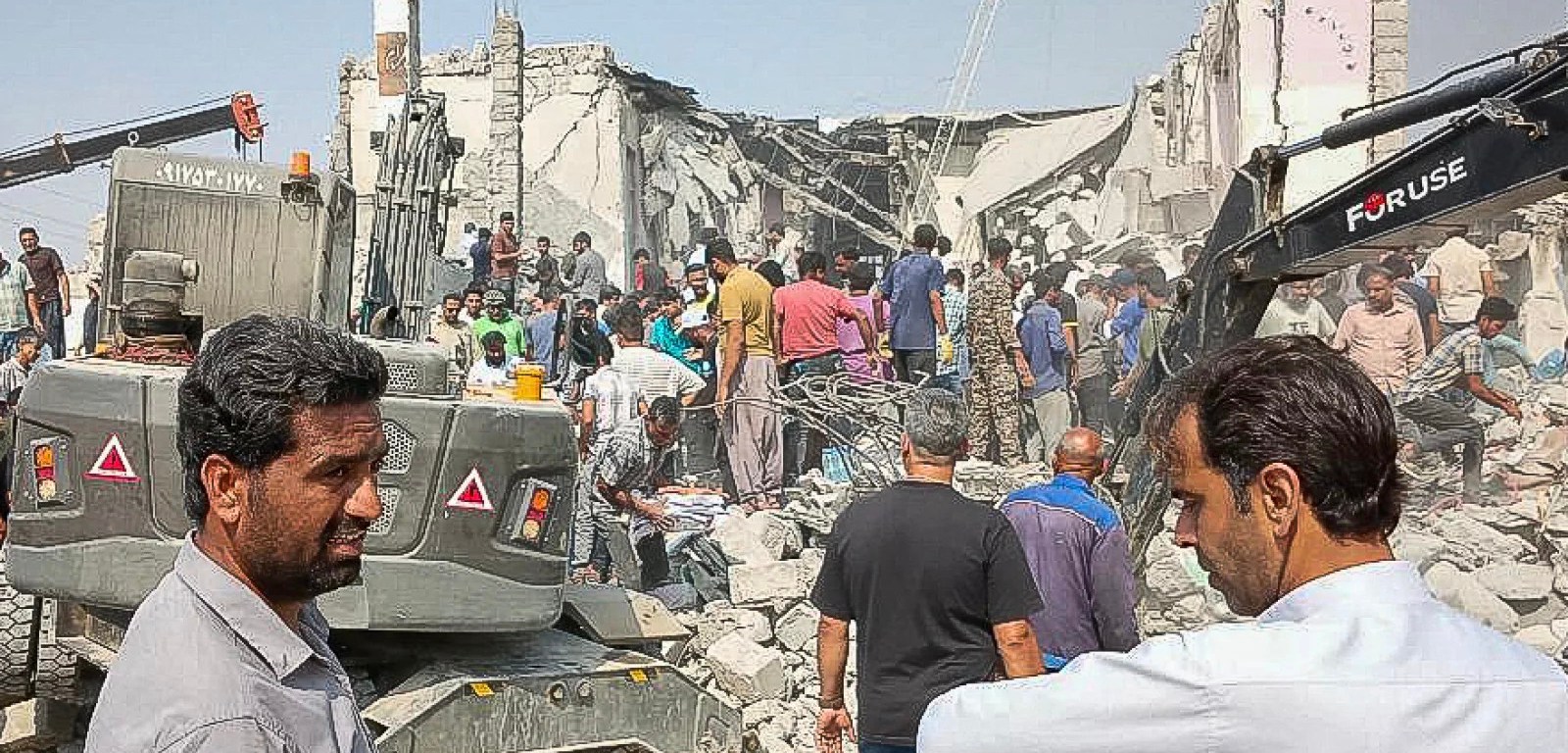
In the early days of the war, the United States and Israel would pelt Iran with countless missiles. In fact, an American missile strike would even result in the slaughtering of over 180 schoolgirls, proving that the true ambitions of the United States and Israel in Iran are not to free the nation, but to take control as swiftly as possible. In fact, the bombing of these schoolgirls in Iran was bad to the point that the United Nations (an international agency aimed at promoting world peace) Education Agency had to come out and say that “the bombing of a primary school during the US and Israeli military attacks on Iran on Saturday constitutes a grave violation of humanitarian law.” When talking about this event, Mr. Painton argued, “These are children. Why did they not care about their protection here? Because, again, it’s a show. It’s a cover story. They don’t really care about children. And to them, they mean nothing. If they’re standing in the way of maximizing their profits, they’ll bomb 10 more schools.” Two images of the aftermath of the event now known as the Minab School Bombing is shown below.
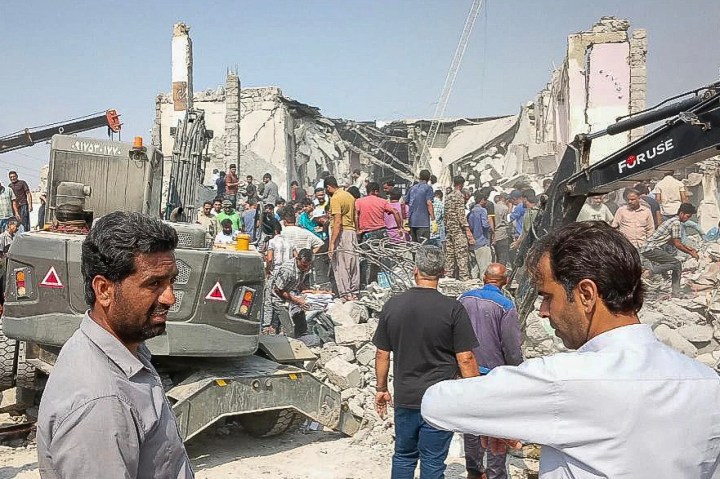
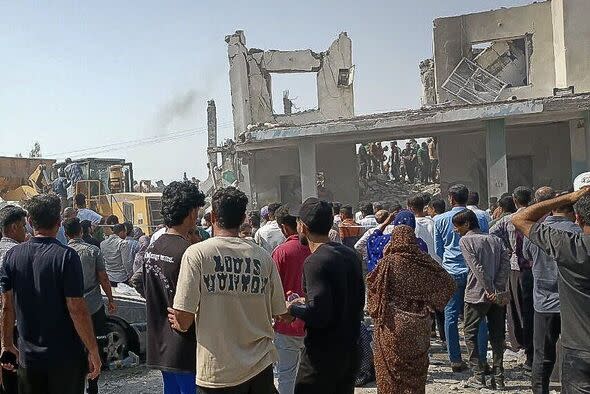
An image of the aftermath of the Minab School Bombing. (AOL.com)
However, the United States and Israel did complete their main goal. They killed Supreme Leader Ayatollah Ali Khamenei on Feb. 26, 2026. While the Iranian regime is still well intact, the United States and Israel are working to change that. Strikes have and will continue to rain on Iran after the death of Khamenei. In fact, on March 17, 2026, Iran’s security chief Ali Larijani was killed. Other leaders who have been killed in strikes are shown below. But why does any of this matter? How has the war affected the world at large?
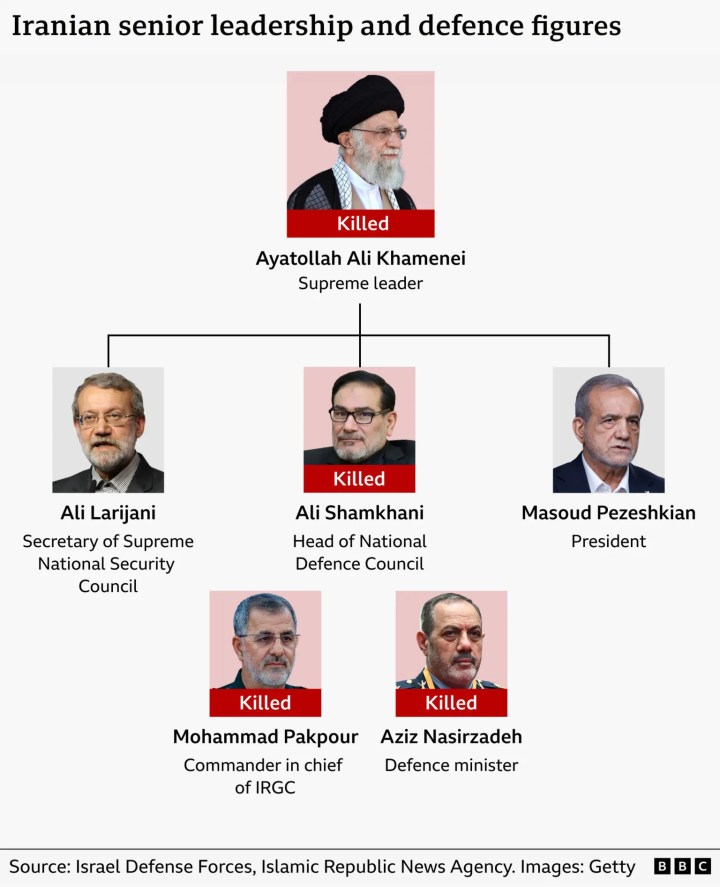
An image detailing the Iranian officials killed thus far in the Iran-USA war. (BBC)
The economic effects of the Iran war have been drastic so far. Oil prices have skyrocketed to over $100 a barrel due to Iran’s closure of the Strait of Hormuz (a key waterway for oil trade). As a result, gas prices have skyrocketed, hindering the transportation of millions worldwide. In addition, the Iran war has already cost American taxpayers at least $11 billion dollars. These are everyday Americans—even some students and teachers at McCaskey who pay taxes—having their tax money put towards war in the Middle East.
As for Iranians, they hope for increased freedom at the cost of economic equality, as shown by what happened the last time the United States imposed a new regime on Iran. Women can hope for newfound freedoms, despite them possibly at the expense of the possibility of not being able to sustain themselves economically due to war costs and privatization, mirroring life in Iran under the CIA-backed Shah.
As for McCaskey, the effects of the Iran war may not be profound at first, but the high cost of the war may come at the expense of schools nationwide, such as McCaskey, as the economy takes a hit from high war spendings. Much like what happened during the Iraq war and Great Recession era, public schools such as McCaskey are poised to be hurt by an economic crisis, no matter the length.
Opinions on the Iran war have been mixed. Some are in full support of the incursion, and others are vehemently opposed to the war. One McCaskey student in support of the actions of the United States is Nikola Draguljić, who argued that “What America is doing isn’t justified, but it is needed. The UN needs to be allowed to act as a global police to keep countries in check. 30,000 people dying just for protesting the government is unfathomable. We need to allow the UN to do more than just write letters. If America didn’t step in, even more Iranians would’ve died.” Unlike Nikola, McCaskey senior Rachelle Kwitch is eminently opposed to the war in Iran. Rachelle argued that “The fact we’re at war because our president needed to shift the media’s focus from his private ‘entanglements’ (in reference to his controversies) is a shame, and now we, the American people, must pay the price.
Before concluding, it is important to compare the different instances of the United States invading other countries mentioned earlier, as they all share one main feature—the American desire for economic control. All of these wars were fought over America’s right to economically imperialize the resources of various states. Mr. Painton would touch on this, arguing that “we (in reference to the United States of America) have real values, and we don’t really care at all about our professed values. That it’s not about democracy and liberty and justice, that it’s about economics, and that’s all that matters to them.” When reflecting on these wars and the current war in Iran, it’s easy to see a pattern of continued imperialism by the United States. As President Trump just launched his invasion of Iran, it does not look like this pattern is coming to an end any time soon. Mr. Painton would give his own unique party-based take on this pattern, claiming that “it’s a game as old as the United States, that we’ve always been doing it. And if we continue to have the two-party system that we have with Democrats and Republicans, we will continue to play this game of empire. You really can’t separate them. They’re both imperialists.”
For years, the United States has pushed its interests and ideologies onto other states. Whether it be Libya, Guatemala, Iran, or Iraq, the United States has continued and seems to be continuing its reckless history of imperialism. While the United States has claimed to be a guarantor of freedom in these regions, the dark lives of those living in American-backed governments say otherwise. In the end, American imperialism has been a problem for centuries, and the war in Iran is proof of the continuation of said problem.
 Vidette