
When an older friend recommended I watch “The Queen’s Gambit,” the recent seven-episode Netflix series about a troubled female chess prodigy, I was skeptical. Chess? It sounded esoteric, boring. But I ended up bingeing the entire series in one weekend. I never expected a show about chess to be so utterly compelling.
Set in the 1960s, the show revolves around Beth Harmon – played by Isla Johnston as a child, then Anna Taylor-Joy for the teen years and beyond – who lands at a bleak Christian orphanage in Kentucky after her mad scientist mother perishes in a car crash. Beth quickly befriends the tough-yet-vulnerable Jolene (who is too often shoved into the sassy Black girl trope), develops an addiction to the tranquilizers the orphanage uses to keep the girls in line, and discovers chess from the inscrutable janitor Mr. Shaibel, who plays the game in the basement. The game consumes her.
Several years later, Beth is adopted by a Lexington couple, leaving behind the orphanage but not her passion for chess. Her adoptive father soon leaves his wife, a deeply depressed alcoholic. This pattern of abandonment inhibits Beth’s ability to connect with others’ – she’s eager for hookups but shies away from commitment, struggling to form relationships not based on chess. Just when Beth and her mother bond, the latter dies a likely alcohol-induced death at one of Beth’s tournaments. The trauma forces her, once again, to grow up too fast, assuming adult responsibility.
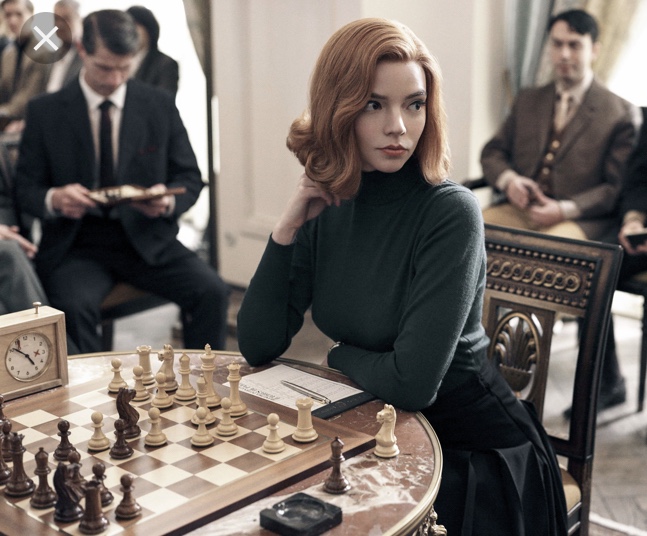
There are 350 chess matches featured throughout the Queen’s Gambit. Yet each one is gripping. Taylor-Joy is sexy and magnetic, the quirks of her mouth by turns flirtatious, calculating, despairing, amused, her lithe hands dancing across the board with a dancer’s sensibility. Beth is a prodigy, and her decisive, intuitive moves reflect that, often in stark juxtaposition with her older, more experienced opponents’ deliberate plays and more intellectual understanding of the game. The camera angles are intimate; you watch Beth ascend through the ranks of a competition alongside her biggest competitor through a split screen, study the board from a birds-eye view, and view the game through Beth’s eyes, creating the illusion that you too are playing, that you too understand chess.
The abundance of British actors is no coincidence: the show has a distinctly British sophistication. Each visual is stunning yet strategic. Beth’s bob (her vivid red hair sets her apart as unconventional from the very beginning) transitions from awkward to glamourous in tandem with her, as she becomes at home in the formidable, male-dominated world of chess. The color palettes of each competition are also very revealing. In fourteen-year-old Beth’s first chess competition in Kentucky, the dull brown shades indicate that she’s too talented for this provincial tournament. In her final competition in Moscow, which determines her status as World Champion, the black-and-white aesthetic emphasizes the stakes, the catharsis of her victory.
Beth is fictional, but I couldn’t help but think that if she were a real person, she would probably succumb to her addictions and likely die young and destitute. In the show, a visit from her old friend Jolene and Mr. Shaibel’s funeral shock her out of her downward spiral. She sobers up remarkably fast and triumphs in Russia. It’s the ending we want, but I don’t think it’s the most realistic one. Yet the markedly reserved, even cold Beth accomplishes none of it alone. Jolene finances her trip out of pocket, her former competitors and friends help her strategize over the phone, her longest-lasting love interest (who turns out to be gay) takes care of her in Moscow. Beth’s prodigious skill is nothing without friendship and community.


You are a great writer!
LikeLike