
At McCaskey High School, a wide range of clubs are offered to support the diverse interests of all students campus-wide. For example, an argumentative student could join McCaskey’s Debate Club, or a student who likes taking pictures could join the FOCUS Photography club. However, none of these clubs stands out quite like McCaskey’s Model United Nations does. But what actually is the club, why should students join it, and why does it matter? McCaskey’s Model UN president, Evie Barr, would offer insight into the club during an interview.
To start, Model UN is a club at McCaskey that simulates the United Nations and its five committees for students. For context, the United Nations is a global organization established in 1945 to promote worldwide cooperation and peace between states. The club’s advisor is McCaskey’s very-own history/economics teacher Drew Wilson. Mr. Wilson runs the club because, as he said, “the club had gone dormant during COVID,” and a few of his students wanted to restart it, so he accepted the responsibility and has continued to advise the club to this day.
To fully understand what the club actually does, one must understand the five Model UN committees. The largest council is the General Assembly, where 1-2 people can represent a country and pass working papers (sets of laws) on certain issues at conferences. The representatives of the country, called delegates, get to speak to the delegation and other delegates to solve these certain issues. The World Health Organization is less popular, but arguably just as important. The council comes together at conferences to discuss a specific global health issue and draft a possible solution. The third committee, the Strategic Response Team, is beloved among club goers. This is because the strategic response team comes together at conferences to simulate global events and explore possible solutions in an alternate timeline, which appeals to many. You also can’t forget about the historical crisis committee, which takes a trip back in time every conference to discuss historical events that require solutions. While all of these committees are interesting in their own right, one has gone unmentioned—the Security Council. The Security Council is intended to maintain global peace. It is the smallest committee, and they meet at every conference to discuss global crises and their possible solutions.
Now that it has been established what Model UN and its committees are, it is time to get to the fun stuff—what the club actually does. McCaskey’s Model UN club president, Evie Barr, would offer insight into this. The main thing Barr mentioned in reference to what the club actually does was “prepare for different conferences.” But what actually are these conferences Barr made light of?
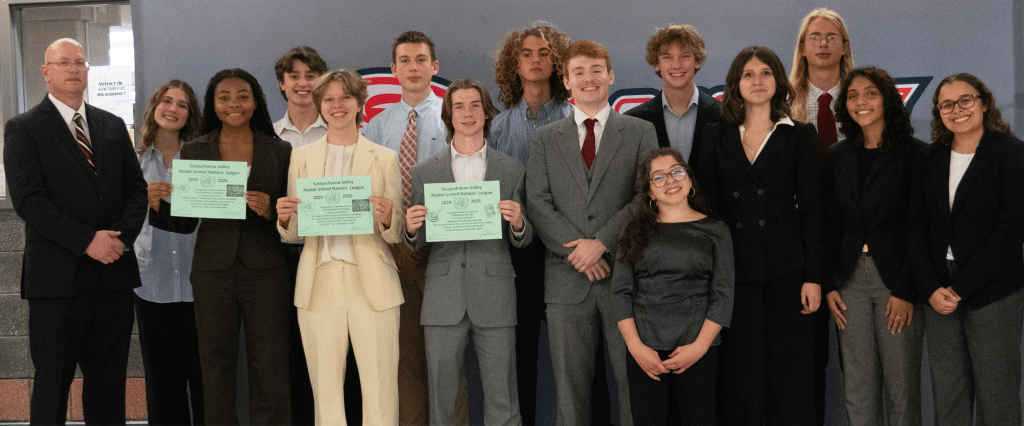
Conferences are events where a collection of high schools in an area bring their Model UN clubs together for a more formal discussion. Typically, there are 5 conferences per year, as is the case this year for McCaskey. In fact, McCaskey hosted a conference on Nov. 11, 2025. Conferences give students across committees an opportunity to engage in cordial debate on a wide variety of issues in a formal setting, which many students find appealing. President Barr said that the best part of the conferences “depends on what committee you are in.” For example, a member of the strategic response team might have a lot of fun simulating an alternate course of events, while a general assembly member might enjoy piping up during discussion to offer a witty rebuttal.
An important aspect of any high school club are the skills they teach their students. After all, what good does a club offer if it is not teaching its members anything? President Barr would offer insight into some of the skills that Model UN teaches its students, starting with public speaking.
Public speaking is important because it builds confidence and communication skills. As students prepare for college, public speaking skills may become a necessity depending on their desired major. Model UN, especially its conferences, builds public speaking skills by forcing students to interact with one another to develop practical solutions to problems.
President Barr would also mention “cooperation” as a skill taught by Model UN. Cooperation is important because students will collaborate frequently in college and in future workplaces, so it is crucial that they develop these skills early. Model UN does this by forcing students to work together to reach a solution to a problem, creating a thoughtful, collaborative environment that effectively teaches students how to collaborate.
Now, what makes Model UN so unique compared to other clubs? President Barr stated that, “Model UN is unique because most other clubs do not have the opportunity to go on field trips throughout the school year.”
After reviewing all this information about the club, it is easy to formulate opinions on why students would like the club. But why should students join the club? President Barr said that students are encouraged to join Model UN because “it’s very fun. And it’s interesting because it’s simulating a real thing, being the United Nations, which is a big part of the world.” Students are also encouraged to join Model UN if they are interested in formal politics or in building essential political literacy.
President Barr would generously give some final pieces of information she wants McCaskey to know about Model UN. Her main message to students is “to join Model UN. It’s very fun.” She also wants McCaskey students campus-wide to know that “it’s important to know about the United Nations and current events.”
The McCaskey Model UN Club has proven to be a club worthy of recognition and joining. The club has gone through its lows, such as dormancy during the pandemic, to reach the highs it has recently attained. In the end, Model UN is a club that teaches students about the United Nations, and for students interested in politics, it may just be the perfect club.
 Vidette